
Most advice on how to improve employee productivity still assumes the problem sits with individual effort. Work harder. Focus longer. Attend one more training. Download one more productivity app.
That advice breaks down in real organizations because low productivity usually starts with system design, not personal discipline. Strong employees lose time in unclear priorities, duplicated approvals, fragmented communication, poor workspace conditions, and constant context switching. A capable team can look slow when the operating model is the primary bottleneck.
The more useful question for executive teams is not, “How can employees do more?” It's, “What friction is the organization creating, and how quickly can leadership remove it?” Productivity rises when leaders reduce noise, clarify ownership, improve manager behavior, and support the physical and mental conditions required for sustained focus.
That's why the best productivity strategy isn't a list of isolated tactics. It's an integrated operating system that connects measurement, management, workspace design, and wellbeing. When those pieces work together, productivity becomes more durable, more measurable, and far less dependent on heroic individual effort.
Why Traditional Productivity Hacks Are Failing Your Workforce
Traditional productivity advice tends to reward visibility over value. It treats busyness as proof of contribution. More meetings, faster replies, fuller calendars, and tighter supervision can create the appearance of momentum while reducing the time available for actual work.
That model fails because modern work is full of hidden friction. Employees spend energy navigating unclear decisions, repetitive administrative work, and communication patterns that interrupt concentration. In many organizations, the highest performers don't need pressure. They need cleaner systems.
The problem isn't effort. It's organizational drag
A team can be engaged, capable, and committed, yet still underperform if managers keep shifting priorities or if work moves through too many handoffs. Productivity drops when people have to guess what matters, chase approvals, or recover from constant interruptions.
Flexible work has strengthened this point. By 2025, productivity was 2.1% higher than pre-2020 levels, and 74% of U.S. companies had adopted remote-flexible arrangements, with remote work share also correlating with higher total factor productivity according to employee productivity findings on hybrid work and flexibility. The lesson is straightforward. Productivity doesn't come from forcing everyone into one rigid way of working. It comes from designing work around focus, outcomes, and sustainable performance.
Practical rule: If leaders can't point to the specific friction slowing a team down, they shouldn't assume the solution is more oversight.
Why isolated perks and isolated tools don't solve it
Another common mistake is treating productivity as a single-program problem. One company adds software. Another adds a wellbeing stipend. Another launches a recognition initiative. Each move can help, but none will hold if the rest of the environment works against it.
A team won't become more productive just because it has access to better technology if goals are vague. It won't sustain higher output if people are exhausted, physically uncomfortable, or expected to stay constantly available. It also won't improve if leaders measure only volume while ignoring quality, collaboration, and speed of decision-making.
That's why a serious productivity strategy starts with architecture. Leaders need a system that measures the right things, aligns work to business priorities, and treats wellbeing as a business input rather than a side benefit.
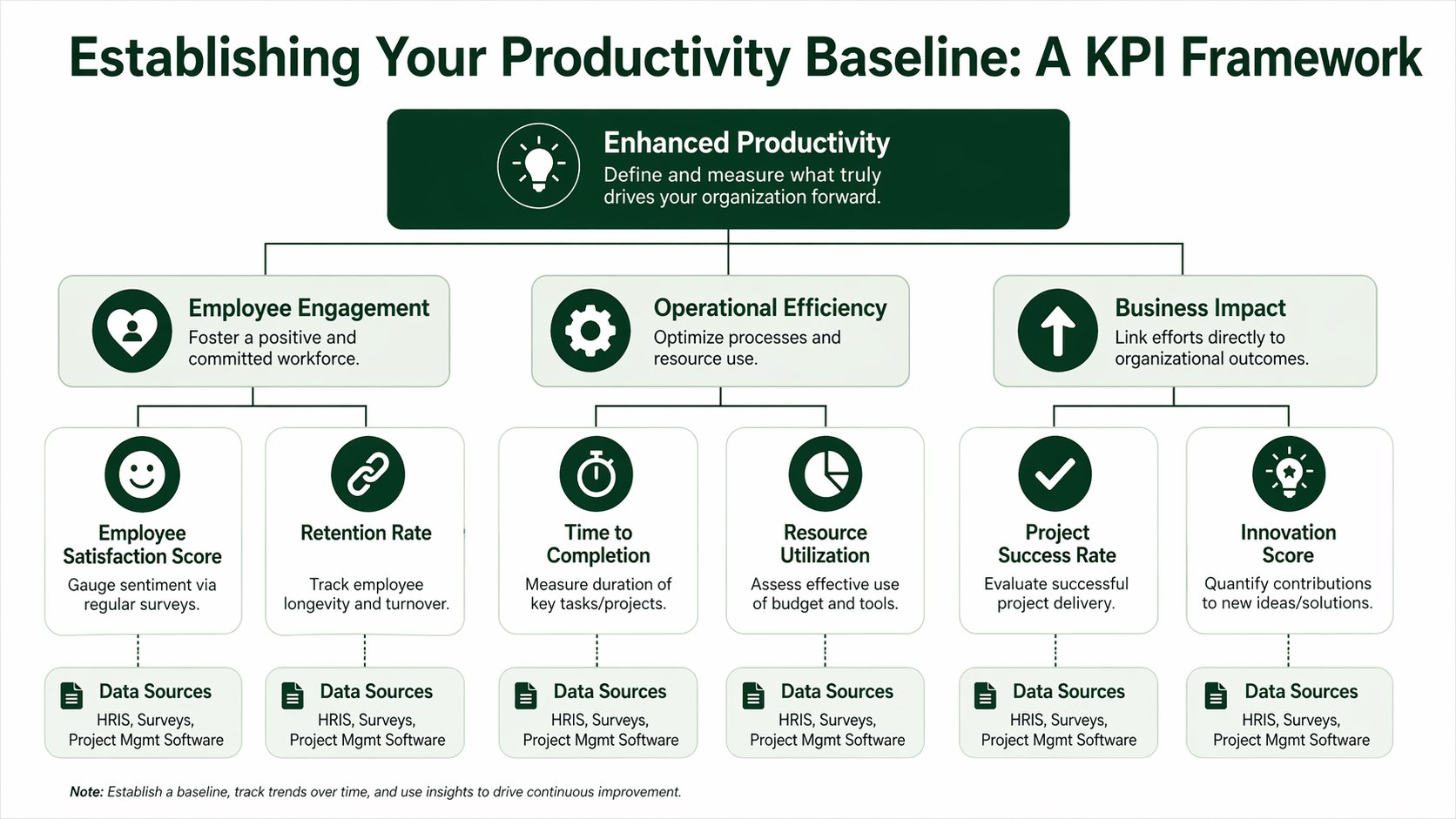
Establish Your Productivity Baseline with the Right KPIs
Most organizations measure productivity too narrowly. They track volume, activity, or utilization and call it a day. That creates blind spots. A team can produce a lot of output while missing deadlines, creating rework, slowing decisions, or damaging collaboration.
A stronger baseline uses a balanced set of indicators. Organizations implementing thorough measurement systems should track output per hour, quality of work, deadline adherence, collaboration impact, and decision-making speed, based on the productivity measurement framework from Bloomfire. Those five indicators work because together they show not just how much work gets done, but how effectively work moves through the business.
Build a balanced scorecard, not a volume report
Each KPI answers a different leadership question.
| KPI | What it reveals | What it prevents |
|---|---|---|
| Output per hour | Whether time is translating into meaningful work | Confusing effort with results |
| Quality of work | Whether output meets standards the first time | High rework hidden behind high volume |
| Deadline adherence | Whether teams can reliably deliver against commitments | Chronic slippage normalized as “busy periods” |
| Collaboration impact | Whether handoffs and shared work improve or slow outcomes | Silo behavior and invisible coordination costs |
| Decision-making speed | How fast the organization turns information into action | Delays caused by unclear ownership or approval overload |
Most productivity failures show up outside raw output. A department may complete its task count while still hurting the business through bottlenecks, low-quality deliverables, or delayed decisions.
Map the actual work before setting targets
The fastest way to build bad benchmarks is to set them from a leadership meeting without understanding how work is performed. The better approach is process mapping. Document the major tasks required to create a product, deliver a service, or support an internal function. Assign clear ownership at each stage. Define what acceptable quality looks like before the work moves forward.
That process should be visual and practical. Leaders can map a workflow from request to completion, identify approval points, note recurring delays, and separate value-adding steps from administrative drag. The point isn't to create a perfect diagram. The point is to expose where time, clarity, and accountability break down.
When employees participate in process mapping, leaders get the truth about how work flows. When they don't, redesign efforts usually miss the real bottlenecks.
Set role-specific SMART benchmarks
A company-wide productivity target sounds neat and usually performs badly. Different roles create value in different ways. A service team, people manager, analyst, and field operator should not be measured by the same benchmark logic.
Use SMART criteria to create role-specific expectations:
-
Specific
Define the task or outcome clearly. “Improve responsiveness” is vague. “Reduce unresolved requests at handoff points” is actionable. -
Measurable
Tie the benchmark to observable work. This can include completion rates, quality thresholds, or cycle-time patterns. -
Achievable
Stretch goals are useful only if employees can influence them through day-to-day actions. -
Relevant
Each benchmark should connect to a business priority, not just local team preference. -
Time-bound
Set a review window so leaders can adjust rather than lock in stale assumptions.
Review benchmarks before they become outdated
Benchmarks should be reviewed quarterly or annually, because business conditions, staffing realities, and customer expectations shift. A target that made sense during one operating cycle may become unrealistic or too easy after a reorganization, a workflow redesign, or a major technology change.
A good review asks three questions:
-
Is the benchmark still aligned to the role's real responsibilities?
-
Has the workflow changed in a way that affects expected performance?
-
Are managers using the metric to coach performance, or just to report it upward?
The last point matters. Metrics should create management clarity, not administrative theater. If the dashboard doesn't help managers remove friction, reprioritize work, or spot capability gaps, it's not a productivity system. It's reporting.
Modernize Management and Align Goals for Greater Impact
Management style often determines whether productivity systems help or hurt. A weak manager can turn clear metrics into surveillance. A strong manager uses the same information to remove barriers, sharpen priorities, and build trust.
Research summarized in the goal alignment and engagement framework from 15Five shows that aligning individual goals with broader business objectives improves productivity. That same framework emphasizes open communication, regular feedback, professional development, and autonomy over work methods. Organizations using it report reduced burnout and stronger accountability. That combination matters because productivity rises when employees understand what matters and have room to execute well.

Replace supervision theater with goal clarity
Micromanagement often looks like control, but it usually signals weak operating discipline. Managers who constantly check status, rewrite work unnecessarily, or insert themselves into every decision create delay and dependency. Employees stop taking ownership because the system punishes initiative.
A better approach is goal cascading. Senior leadership sets a small number of business priorities. Functional leaders translate those into team outcomes. Managers then convert those outcomes into role-level commitments that employees can influence directly.
That chain should be visible and simple:
| Level | Leadership question | Example of focus |
|---|---|---|
| Business priority | What must the organization achieve? | Faster delivery, better retention, stronger service quality |
| Team outcome | What must this function improve? | Shorter cycle times, cleaner handoffs, better issue prevention |
| Individual goal | What will this employee own? | Clear deliverables, decision rights, quality standards |
When people understand that chain, productivity improves because work stops feeling random.
Use feedback as an operating rhythm
Annual reviews can't carry a productivity strategy. Teams need a repeatable management rhythm that keeps priorities current and obstacles visible. That usually means structured one-to-ones, shorter performance check-ins, and project-based retrospectives.
Managers should use those conversations to address four practical questions:
-
What should this person focus on right now?
-
What's slowing progress?
-
What support or development would improve execution?
-
Where can the employee make more decisions without manager intervention?
That final question often gets ignored. Yet autonomy is one of the strongest productivity levers available to a manager. When employees know the outcome, understand boundaries, and have authority over method, work moves faster and accountability becomes more real.
Strong managers don't ask for constant updates. They define success, remove barriers, and let capable people work.
Recognition and development are performance tools
Recognition is often treated as culture work rather than productivity work. That's too narrow. Public acknowledgment helps reinforce what high-value contribution looks like. It tells the wider team which behaviors support results, collaboration, and quality.
Professional development matters for the same reason. If productivity problems come from capability gaps, no amount of pressure will solve them. Managers need to link coaching, stretch assignments, and mentorship to the actual skills required for better execution.
For organizations expanding their support model, digital employee health and wellness platforms can also help managers connect wellbeing visibility with employee experience efforts. That doesn't replace leadership. It gives leadership better infrastructure.
Integrate Wellness into Your Workspace and Workflow
Most companies still separate productivity strategy from wellbeing strategy. One sits with operations. The other sits with benefits or culture. That split no longer makes sense.
The practical reality is simple. Employees do better work when the work environment supports concentration, physical comfort, recovery, and sustainable energy. Wellness is not the soft side of productivity. It is part of the operating model.
Data cited in the wellness and productivity analysis from GetFlip shows 25-30% productivity gains from holistic wellness programs in major markets, and hybrid teams with wellness integration report 22% higher output. The same analysis notes that many HR leaders and property operators still lack clear frameworks for deploying and measuring these programs. That gap is one reason many organizations leave real performance gains untouched.

Start with the physical workspace
Physical friction erodes performance. Poor seating, weak lighting, inadequate private space, and awkward layout all increase fatigue and reduce focus. Employees may not frame those issues as productivity barriers, but they change how long people can work well before attention drops.
A strong workplace strategy looks at three layers:
-
Ergonomic fit
Workstations, seating, and screen setup should support sustained comfort for different roles and body types. Organizations refining this area should understand the goal of ergonomics in workplace design. -
Activity-based space
Not all work should happen in the same setting. Teams need spaces for collaboration, quiet concentration, confidential conversations, and brief recovery. -
Onsite recovery options
Fitness access, therapeutic services, and practical wellbeing resources make it easier for employees to reset during the workday rather than carrying stress through it.
Redesign the digital environment, too
A beautiful office won't fix notification overload. Many productivity losses happen in the digital workspace, where people are pulled into fragmented communication all day long. If every message is urgent and every platform is open, focus collapses.
Leadership teams should address digital friction directly:
-
Create protected focus windows
Reserve parts of the day when internal interruptions are minimized. -
Set response norms
Clarify which channels require immediate replies and which do not. -
Reduce meeting sprawl
Eliminate recurring meetings that exist without a clear decision or delivery purpose. -
Limit duplicate reporting
Don't make teams update multiple systems with the same information.
These changes matter because wellness is not only about stress management after work. It is also about reducing the strain built into work itself.
A productivity plan fails when it asks employees to recover from a system that keeps exhausting them.
Treat personal wellbeing as a business input
Many executive teams often hesitate on this point. Wellness can sound intangible until it is tied to performance conditions. But the business logic is direct. Employees think more clearly, collaborate better, and stay more consistent when organizations support energy, mobility, nutrition, and mental health in practical ways.
That does not require turning the workplace into a clinic. It requires making support usable. The most effective programs are integrated into the flow of work, accessible to both desk-based and distributed teams, and reinforced by manager behavior. If leaders encourage time off but praise constant availability, the message collapses. If they promote resilience but overload calendars, the system contradicts itself.
Wellness programs become strategic when they are measurable against operational outcomes. That means tracking usage patterns, manager participation, employee feedback, and selected performance indicators from the baseline framework. Once leaders make that link, wellness stops looking like a perk and starts functioning as a capacity investment.
Develop Your Implementation Roadmap and ROI Case
A productivity strategy only matters if leadership can operationalize it. That means starting small enough to learn, structured enough to measure, and credible enough to scale.
The most effective approach is a pilot. Choose one business unit or cross-functional team with visible work, manageable complexity, and a leader willing to participate seriously. Avoid selecting a team in active crisis. Avoid selecting a team that is already over-optimized and unlikely to reveal useful lessons.

Build the pilot around a few controllable variables
A sound pilot usually includes four design choices:
| Decision area | What leadership should define |
|---|---|
| Population | Which team, roles, and manager group will participate |
| Baseline | Which KPI patterns will be measured before changes begin |
| Interventions | Which workflow, management, wellness, or workspace changes will be tested |
| Review cadence | How leaders will inspect progress and adjust during the pilot |
Many initiatives drift; they launch too many changes at once and can't tell what worked. A better sequence is to test a small set of interventions tied to known friction. For example, one pilot may combine clearer manager check-ins, fewer approval steps, and a workspace reset. Another may combine deep-work blocks, wellness access, and better decision ownership.
Use AI where it removes repetitive work
Technology should amplify judgment, not create more administrative burden. The strongest use cases are repetitive tasks, information synthesis, and support for faster problem-solving.
According to the AI and productivity findings summarized by High5Test, a Federal Reserve Bank experiment found that issue resolution per hour increased by 15% when employees used AI assistance. The same source notes that generative AI usage correlates with 33% higher productivity per AI-assisted hour, and that U.S. labor productivity rose 3.3% annualized in Q2 2025. Those figures don't mean every AI deployment works. They do show why executive teams should treat AI as a serious productivity lever when paired with strong processes and role clarity.
Leaders should keep the use case narrow at first:
-
Administrative drafting for routine communication
-
Summarization support for large information sets
-
Knowledge retrieval for internal questions
-
Pattern spotting in recurring operational issues
What won't work is rolling out AI broadly without governance, training, or workflow redesign. That tends to increase confusion rather than output.
Make the ROI case in operating terms
Executive boards rarely approve productivity programs because the language sounds appealing. They approve them when the business case is clear. That case should be framed in operational terms, not just cultural aspiration.
A practical ROI model should include:
-
Current baseline
What are the team's present performance patterns across the chosen KPIs? -
Expected operational gain
Which metric should move, and why is the intervention likely to influence it? -
Cost to implement
Include program delivery, manager time, communications effort, and workspace adjustments. -
Value of improved throughput or quality
Translate better productivity into faster delivery, cleaner execution, or stronger service outcomes. -
Secondary workforce effects
Include likely impact on burnout risk, manager effectiveness, and workforce stability qualitatively unless the business has internal numbers to support more precise estimates.
Boards respond to productivity proposals that connect human factors to execution risk. They dismiss proposals that frame wellbeing as goodwill without operational accountability.
For onsite environments, supportive amenities can strengthen the case when they are tied to usage and performance goals. A workplace leader considering a gym at the office as part of a broader wellbeing strategy should position it as one component of an integrated model, not as a standalone benefit.
Communicate change like an operating shift
Employees usually resist productivity programs when they believe measurement will be used against them. Communication should remove that fear quickly. Leaders should explain what is changing, why it is changing, what will be measured, and how employee input will shape the rollout.
A credible communication plan does three things well:
-
States the business purpose clearly
The goal is to remove friction and improve how work gets done. -
Explains the employee benefit
Better systems should reduce wasted effort, role confusion, and burnout. -
Creates visible feedback loops
Employees need a way to identify what is helping and what is getting worse.
That transparency is essential. Productivity initiatives fail when leaders announce them as performance programs but run them like surveillance programs.
Sustaining Productivity as a Cultural Pillar
Sustained productivity comes from repetition, not campaigns. The organizations that improve employee productivity over time do three things consistently. They measure what matters, manage with clarity and trust, and nurture the conditions that let people perform well without burning out.
Those three moves reinforce each other. Better measurement helps managers coach more effectively. Better management makes wellness and workspace investments more usable. Better wellbeing makes it easier for employees to deliver quality work, make sound decisions, and collaborate without unnecessary drag.
This is why productivity should be built into hiring, onboarding, manager training, workspace planning, and performance reviews. It should shape how teams set goals, how leaders run meetings, how offices are designed, and how recovery is normalized. When organizations treat productivity as a cultural outcome rather than a quarterly fix, they stop chasing short bursts of output and start building reliable execution.
The strongest executive teams already know this. A high-output culture is rarely the one asking people to give more of themselves. It is the one that has designed work well enough that people can perform at a high level, consistently, and stay well while doing it.
Organizations ready to turn wellbeing into a measurable productivity advantage can explore Excel Wellbeing Solutions. Their workplace wellness programs help employers integrate medical testing, massage therapy, nutrition guidance, and mental health support into the flow of work, giving HR and workplace leaders a practical way to strengthen focus, resilience, and performance.