
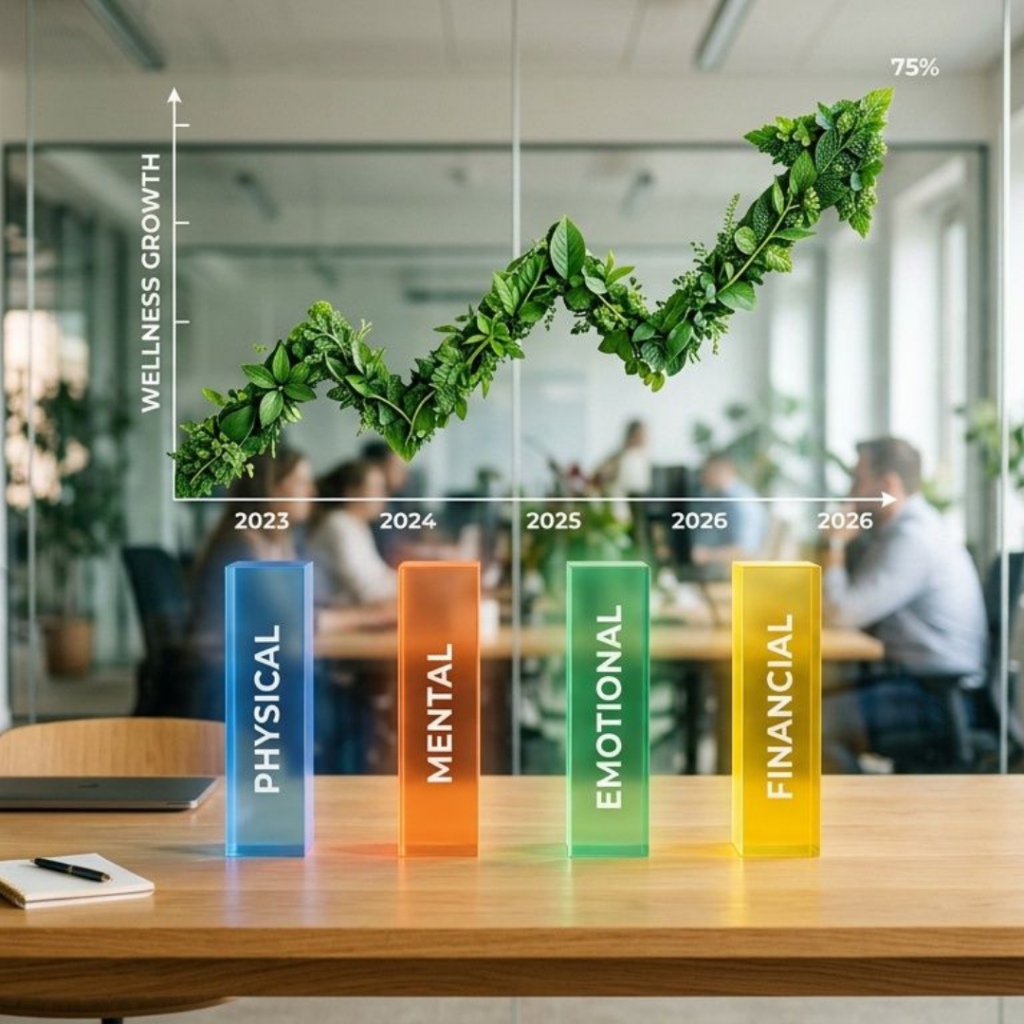
Wellness programs don't get approved because they sound good.
They get approved when they show value.
Some organizations report strong returns. Others see little impact beyond participation. That gap is what matters.
Corporate wellness program benefits become meaningful when they are tied to cost, workforce performance, and measurable outcomes—not just engagement.
The Real Business Case for Wellbeing
Wellbeing isn't separate from business performance.
It shows up in:
- Medical spend
- Unplanned absence
- Turnover
- Day-to-day output
For leadership teams, the question isn't whether wellbeing is positive.
It's whether a structured program can improve these outcomes in a measurable way.
What leadership needs to hear
A credible program should demonstrate:
- Cost impact – reducing avoidable expense
- Performance stability – improving consistency at work
- Targeted design – solving a defined workforce problem
- Measurable outcomes – holding up under finance review
Boardroom test:
If a program can't connect to a business metric, it won't survive budget scrutiny.
Moving Beyond Perks to a Strategic Model
Perks create visibility. Systems create results.
A smoothie day or occasional class may be appreciated—but they rarely change outcomes on their own.
A strategic model aligns:
- Workforce needs
- Leadership behavior
- Work design
- Program delivery
- Measurement
What a strong framework includes
High-impact programs typically combine:
- Physical support – movement, ergonomics, recovery
- Mental support – stress management and access to help
- Nutritional support – practical, everyday habits
- Cultural reinforcement – manager and team behavior
The difference isn't the number of services.
It's how well they fit into daily work.

Why Design Matters More Than Availability
Most organizations don't have a supply problem. They have a usage problem.
Employees don't reject wellbeing programs.
They reject programs that don't fit their work reality.
Common barriers include:
- Time constraints
- Scheduling conflicts
- Lack of trust
- Low relevance
- Manager behavior
Practical rule:
If employees have to work around the program to use it, it won't scale.
How Wellbeing Impacts Performance
The strongest benefit isn't satisfaction. It's performance.
When programs are usable:
- Absence decreases
- Focus improves
- Teams experience less disruption
- Managers spend less time covering gaps
These changes compound across the workforce.
What changes operationally
Inside the business, that looks like:
- More stable schedules
- Better handoffs and collaboration
- Less fatigue-driven underperformance
- Higher day-to-day consistency
Productivity improves when friction is reduced—not when effort increases.
Understanding ROI: Where Value Comes From
Wellness ROI rarely sits in one place.
It typically shows up across:
- Medical spend
- Absence and disruption
- Disability and safety exposure
- Retention and replacement cost
Each may show modest improvement. Together, they create meaningful value.
Why ROI takes time
Wellness behaves more like a risk-management investment than a quick return.
Early signals:
- Participation
- Employee sentiment
Mid-term signals:
- Absence patterns
- Engagement shifts
Long-term signals:
- Claims trends
- Retention
Expecting immediate financial return often leads to poor decisions.
Measuring What Actually Matters
Participation alone isn't enough.
A strong measurement model includes:
Leading indicators
- Participation and engagement
- Repeat usage
- Employee feedback
Lagging indicators
- Absence trends
- Retention
- Productivity signals
- Healthcare cost patterns
Each plays a different role.
What finance should look for
- Participation across target groups—not just averages
- Sustained engagement—not one-time activity
- Changes in behavior—not just access
- Movement in business metrics—not just sentiment
If metrics don't connect, the program won't hold up.

Common Pitfalls to Avoid
Most programs fail in execution, not intent.
1. Selection bias
Programs attract already-engaged employees
2. Over-reliance on participation
Usage without outcome measurement
3. Poor targeting
No defined workforce problem
4. Accessibility gaps
Programs that don't fit real schedules or roles
How to Build a Stronger Program
A better approach is focused and disciplined.
Start with a clear objective
Choose one or two outcomes:
- Reduce absence
- Improve retention
- Support productivity
Design for real-world use
Ensure:
- Easy access
- Manager support
- Minimal friction
Measure before and after
Set:
- Baselines
- Target populations
- Clear success criteria
Adjust based on evidence
- Expand what works
- Redesign what doesn't
- Cut low-value activity
Final Takeaway
Corporate wellness programs don't deliver value by default.
They deliver value when:
- They solve a real workforce problem
- Employees can actually use them
- Leaders measure outcomes—not just activity
That's what turns a benefit into a business investment.
Excel Wellbeing Solutions helps organizations design workplace wellbeing programs that align with workforce needs and measurable business outcomes.
For enterprise leaders, the focus should be on building programs that drive performance—and can be defended with data.