
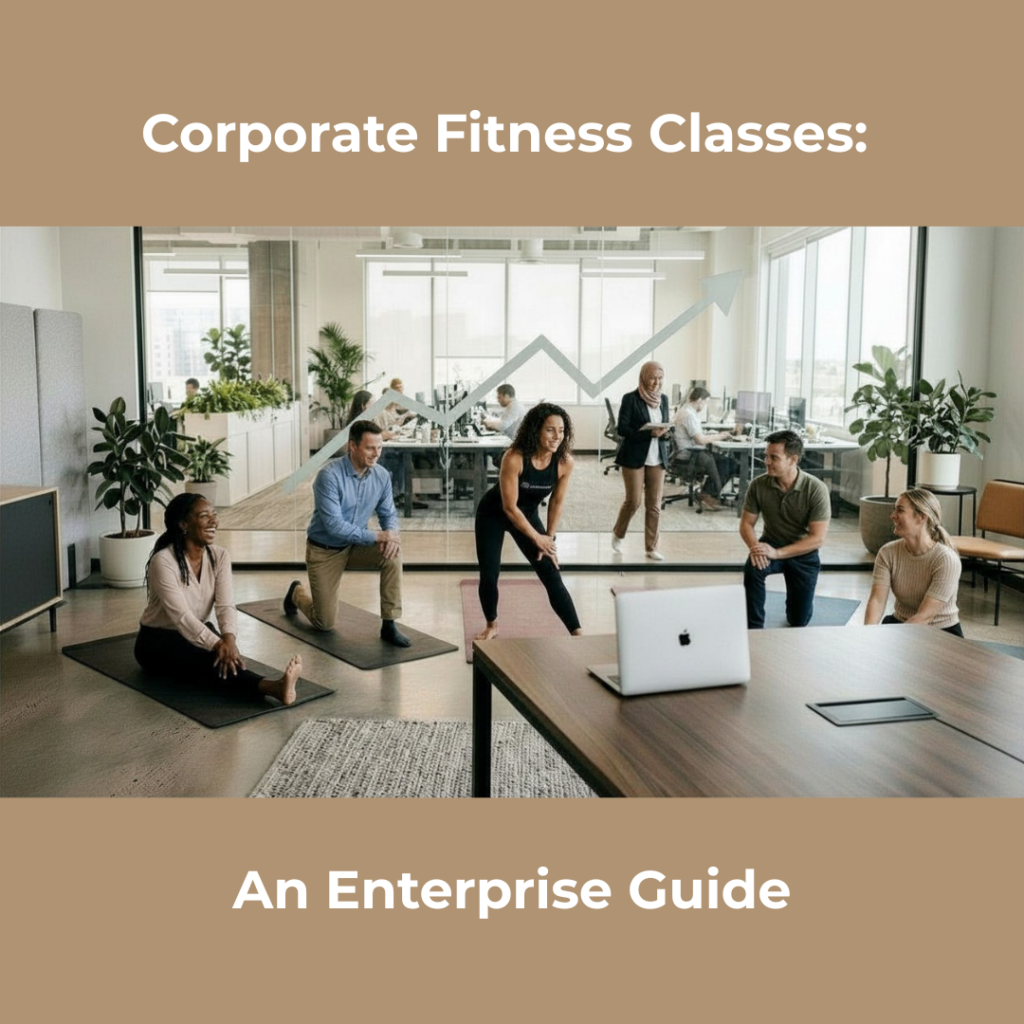
Corporate fitness classes are no longer viewed as simple workplace perks.
For enterprise organizations, they are increasingly tied to:
- Workforce engagement
- Employee experience
- Participation in wellbeing programs
- Retention and culture
- Operational consistency
That changes how these programs should be designed.
The strongest organizations don't start with class schedules. They start with workforce realities, participation barriers, and measurable business goals.
Why Corporate Fitness Classes Matter
Executives are not funding exercise for its own sake.
They are investing in:
- Sustainable workforce performance
- Stronger employee connection
- Repeat engagement with wellbeing programs
- Better participation visibility across teams
Fitness classes work particularly well because they create recurring participation habits—not just one-time awareness.
Employees can:
- Join together
- Build routines
- See visible leadership participation
- Re-engage consistently over time
That makes fitness classes easier to manage and measure than many broader wellbeing campaigns.
From Perk to Program
The difference between a perk and a program is operational discipline.
A perk:
- Exists passively
- Serves whoever happens to use it
- Has limited measurement
A program:
- Is designed around workforce access
- Tracks participation and repeat use
- Aligns with business goals
- Adjusts based on data
Practical rule:
If leaders cannot define the target employee group, access model, and success metric before launch, the program is not ready.

Building the Business Case
The strongest business cases are operational—not emotional.
Leadership teams want to understand:
- Who the program serves
- How participation will scale
- What outcomes will be measured
- Whether the investment can be managed effectively
Why finance leaders support fitness programs
Corporate fitness classes generate measurable operational data:
- Attendance
- Repeat participation
- Fill rates
- Cost per session
- Participation by location or workforce group
That visibility matters.
Unlike broad awareness campaigns, fitness classes create recurring participation patterns that can actually be reviewed and optimized.
Where programs usually fail
Most failures come from poor workforce fit.
Common problems:
- Schedules that only work for office staff
- Weak manager support
- Limited remote access
- Poor communication
- No reporting discipline
A program that only works for headquarters employees will struggle to justify enterprise investment.
Choosing the Right Delivery Model
Most organizations use one of three approaches:
- Onsite
- Virtual
- Hybrid
The right model depends on how employees actually work.
Onsite classes
Best for:
- Headquarters environments
- Stable onsite populations
- Large campuses
Strengths:
- Strong visibility
- Community building
- Easy routine formation
Limitations:
- Limited reach across distributed teams
- Schedule dependency
- Space constraints
Virtual classes
Best for:
- Remote teams
- Distributed workforces
- Multi-state organizations
Strengths:
- Broad access
- Flexible scheduling
- Lower facility dependency
Limitations:
- Lower local connection
- Requires strong communication
- Easier to disengage from over time
Hybrid programs
For most enterprise employers, hybrid is the strongest long-term model.
Why?
Because most organizations now operate across:
- Office environments
- Remote work
- Regional teams
- Shift-based populations
Hybrid delivery gives employees multiple access points without forcing one format onto everyone.

Designing for Workforce Reality
Programs fail when access depends on:
- One office
- One time slot
- One type of schedule
Strong enterprise programs are designed around employee context.
That means accounting for:
- Shift workers
- Hybrid schedules
- Time zones
- Travel-heavy roles
- Frontline employees
- Remote teams
Remove participation barriers early
Participation depends more on access than content.
Strong programs typically include:
- Multiple session times
- Short-format classes
- On-demand options
- Beginner-friendly formats
- Simple enrollment processes
If participation requires extra effort or approvals, adoption drops quickly.
Inclusion Is an Operating Decision
Inclusive design goes beyond fitness level.
Ask:
- Can frontline employees realistically participate?
- Can remote employees access the same quality experience?
- Do schedules fit different workforce patterns?
- Are communications practical and easy to follow?
If the answer is no for major employee groups, the design needs adjustment.
Community Drives Participation
Flexibility matters—but connection still drives engagement.
Strong programs create:
- Visible participation
- Team interaction
- Shared routines
- Leadership involvement
That's what helps fitness programs sustain momentum after launch.

Measuring Corporate Fitness ROI
Participation alone is not enough.
A strong measurement model tracks both:
- Program performance
- Workforce relevance
Core operational metrics
Track:
- Participation percentage
- Repeat attendance
- Cost per participant
- Utilization by format and location
- Access across workforce groups
These metrics help organizations identify:
- Which sessions deserve expansion
- Which formats underperform
- Which employee groups are underserved
Connect the program to business outcomes
Fitness programs should support broader workforce goals such as:
- Employee engagement
- Retention
- Reduced absence pressure
- Improved employee experience
The key is directional alignment—not overclaiming causation too early.
What not to overvalue
Weak metrics include:
- Total registrations
- Launch-day attendance alone
- One-time participation spikes
Better questions:
- Which sessions build repeat behavior?
- Which employee groups are consistently excluded?
- Which formats justify delivery cost?
Your Implementation Roadmap
Strong implementations follow a clear sequence.
Step 1: Assess workforce needs
Understand:
- Schedules
- Locations
- Access barriers
- Participation conditions
Avoid designing around headquarters alone.
Step 2: Build the internal business case
Define:
- Target populations
- Delivery model
- Ownership structure
- Reporting cadence
- Success metrics
Keep the language operational and measurable.
Step 3: Launch a focused pilot
Start with:
- Limited formats
- Clear participation goals
- Defined workforce groups
Then expand based on evidence.
Step 4: Communicate clearly
Employees should immediately understand:
- What's available
- Who it's for
- How to participate
Good communication reduces friction.
Step 5: Review and optimize
The first schedule is rarely the final schedule.
Strong programs:
- Adjust weak time slots
- Expand high-performing formats
- Refine communication
- Reassess workforce fit regularly
Optimization is part of the operating model.
Choosing the Right Wellbeing Partner
The best partner is not the one with the largest class catalog.
It's the one that understands enterprise workforce complexity.
Look for:
- Hybrid and multi-site capability
- Strong reporting and analytics
- Experience with distributed workforces
- Operational implementation support
- Flexible delivery models
A provider should be able to explain how participation will work outside ideal conditions—not just describe the classes themselves.
Final Takeaway
Corporate fitness classes create value when they are designed around workforce access, participation, and operational discipline.
The strongest programs:
- Fit how employees actually work
- Remove participation barriers
- Produce measurable engagement data
- Support broader workforce goals
That's what turns fitness classes from a perk into a scalable workforce strategy.
Excel Wellbeing Solutions helps organizations design onsite, virtual, and hybrid corporate fitness programs that support employee engagement, workforce performance, and measurable wellbeing outcomes.
For enterprise leaders, the goal is clear: create programs employees can realistically use—and leadership can confidently evaluate.