
Most advice on productivity focuses on individual effort.
Work harder. Stay focused. Use better tools.
That approach breaks down in real organizations.
Low productivity is rarely a discipline problem. It's usually a system problem.
Strong employees lose time to unclear priorities, repeated approvals, fragmented communication, and constant interruption. A capable team can look slow when the operating model creates friction.
The better question for leadership is:
Where is the organization slowing people down—and how quickly can that friction be removed?
Productivity improves when leaders simplify systems, clarify ownership, improve management behavior, and support the conditions required for sustained focus.
Why Traditional Productivity Advice Fails
Many productivity strategies reward activity instead of outcomes.
More meetings, faster replies, and fuller calendars create the appearance of momentum—but reduce time for meaningful work.
Modern work is full of hidden friction:
- Unclear decisions
- Administrative overload
- Constant interruptions
- Poor communication flow
The issue isn't effort. It's organizational drag.
Even engaged teams underperform when priorities shift constantly or work moves through too many layers.
Productivity Starts With System Design
Productivity isn't solved with isolated tools or perks.
Adding software, benefits, or incentives won't work if the environment stays the same.
A team won't improve if:
- Goals are unclear
- Workflows are inefficient
- Managers create unnecessary oversight
- Employees are fatigued or distracted
That's why productivity needs to be treated as a system—not a set of tactics.
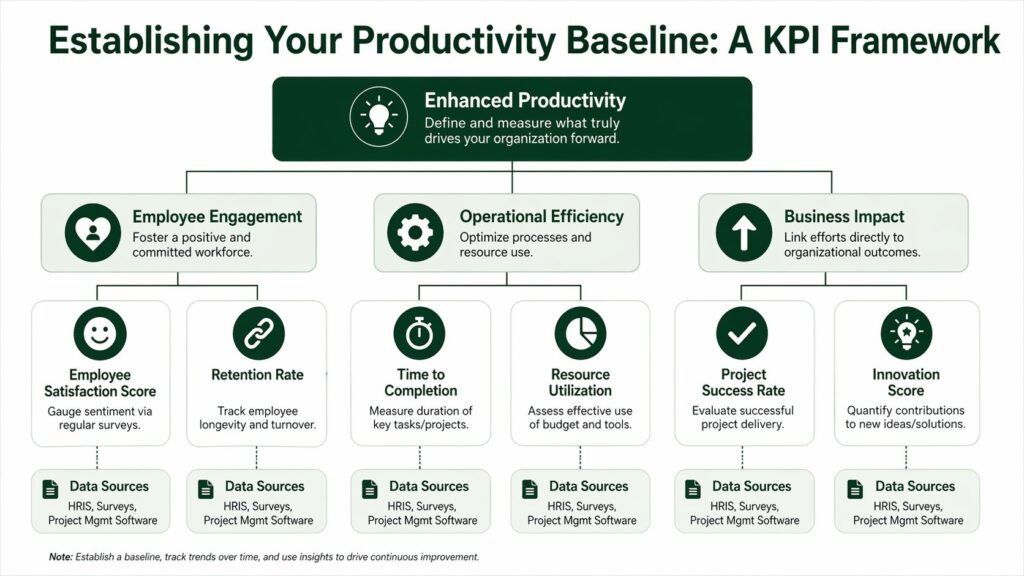
Establish a Clear Productivity Baseline
Most organizations measure productivity too narrowly.
Tracking volume alone creates blind spots.
A stronger approach uses a balanced set of metrics:
- Output per hour – Is time producing meaningful work?
- Quality of work – Is output right the first time?
- Deadline adherence – Are commitments reliable?
- Collaboration impact – Do handoffs help or slow progress?
- Decision speed – How quickly does work move forward?
These metrics show how effectively work flows—not just how much gets done.
Map the Work Before Setting Targets
Poor benchmarks usually come from guessing.
Instead, map how work actually happens:
- Identify key steps from start to finish
- Define ownership at each stage
- Highlight delays and bottlenecks
- Separate value-added work from administrative tasks
When employees are involved in this process, leaders uncover real friction points.
Set Role-Specific Expectations
A single productivity target rarely works.
Different roles create value in different ways.
Use clear, role-specific benchmarks:
- Define outcomes clearly
- Tie metrics to real work
- Ensure employees can influence results
- Review regularly as conditions change
Metrics should guide decisions—not just reporting.
Improve Management, Not Oversight
Management style has a direct impact on productivity.
Weak management increases friction. Strong management removes it.
Micromanagement slows work by creating dependency and delays.
A better model focuses on:
- Clear goals
- Defined ownership
- Reduced approval layers
- Consistent feedback
When employees understand expectations and have autonomy, work moves faster.
Align Goals Across the Organization
Productivity improves when work feels connected.
Use a simple structure:
- Business priorities = What the organization must achieve
- Team outcomes = What each function contributes
- Individual goals = What each employee owns
When this alignment is clear, effort becomes more focused and less reactive.
Build a Strong Management Rhythm
Annual reviews aren't enough.
Managers need a consistent operating rhythm:
- Regular one-to-ones
- Short check-ins
- Project reviews
These conversations should focus on:
- Current priorities
- Barriers to progress
- Support needed
- Opportunities for more autonomy
Strong managers don't monitor constantly. They remove obstacles and let people work.
Integrate Wellbeing Into Productivity
Productivity and wellbeing are often treated separately. They shouldn't be.
Employees perform better when:
- They can focus without interruption
- They are physically comfortable
- They have time to recover
- Energy levels are sustainable
Wellbeing is not a side benefit. It's part of the operating model.

Improve the Physical Workspace
Physical friction reduces performance.
Focus on:
- Ergonomic setup
- Lighting and noise
- Access to quiet and collaborative spaces
- Opportunities for short recovery breaks
Small changes in workspace design can significantly improve focus and stamina.
Reduce Digital Friction
Many productivity losses happen in the digital environment.
Address:
- Notification overload
- Unclear response expectations
- Excessive meetings
- Duplicate reporting
Simple changes help:
- Set focus blocks
- Define communication norms
- Eliminate unnecessary meetings
- Streamline systems
A productive team needs uninterrupted time to think.
Use Technology Strategically
Technology should reduce work—not create more of it.
Effective use cases include:
- Automating repetitive tasks
- Summarizing information
- Supporting faster decisions
Start small and focused. Poor implementation adds confusion instead of value.
Build a Practical Implementation Plan
Productivity strategies work best when tested.
Start with a pilot:
- Select one team
- Define baseline metrics
- Test a small number of changes
- Review results regularly
Avoid rolling out too many changes at once.
Build the Business Case
Leaders fund productivity improvements when the impact is clear.
A strong case includes:
- Current performance baseline
- Expected improvements
- Implementation cost
- Business value (output, speed, quality)
Frame the case in operational terms—not abstract benefits.
Communicate the Change Clearly
Employees resist productivity programs when they feel like surveillance.
Communication should:
- Explain the purpose
- Highlight benefits to employees
- Provide feedback channels
Transparency builds trust—and adoption.
Sustaining Productivity Over Time
Productivity isn't a one-time initiative.
It requires consistency in:
- Measurement
- Management behavior
- Work design
- Support systems
Organizations that treat productivity as part of their operating model—not a temporary fix—see more stable results.
Final Takeaway
Improving productivity isn't about pushing employees harder.
It's about designing work better.
When systems are clear, managers are aligned, and employees are supported, performance becomes more consistent—and easier to sustain.
Excel Wellbeing Solutions helps organizations integrate wellbeing into everyday work, supporting focus, recovery, and sustained performance across teams.
For HR leaders looking to improve productivity, the focus should be on reducing friction, aligning systems, and building conditions that support consistent output.