
Most workplace wellness advice follows a simple assumption:
Offer a program - increase participation - productivity improves.
The reality is more complicated.
Some programs show measurable gains. Others show little to no impact on core business outcomes. That inconsistency matters, because it changes the question leadership should be asking.
This isn't about whether wellness is good in principle.
It's about whether a specific program, designed for a specific workforce, can deliver measurable results.
For HR and benefits leaders, this is a capital allocation decision—not a philosophical one.
The Problem With the Standard Wellness Model
Many organizations still approach wellness like a perk portfolio.
They offer a mix of initiatives, promote participation, and measure success through attendance or engagement. Those signals matter—but they don't answer the executive question:
Did this improve workforce performance in a measurable way?
A fitness challenge, a yoga class, and a targeted ergonomics or mental wellbeing strategy may all sit under the same budget. But they don't operate the same way—and they shouldn't be evaluated the same way.
Why the “Wellness = Productivity” Narrative Persists
The idea that wellness improves productivity is appealing—and easy to accept.
It persists for three main reasons:
- It feels intuitively true
- It's easy to communicate internally
- It's often measured incorrectly
Most programs track activity, not outcomes.
Participation can rise while productivity remains unchanged. That disconnect is where many programs lose credibility.
Wellness works best when treated as an operational intervention—not a visibility exercise.
What the Research Actually Shows
The data is mixed—and for good reason.
What the strongest skeptical evidence shows
A large randomized controlled trial found no meaningful improvement in job performance, absenteeism, or spending—even though employee behaviors improved.
This highlights a key issue:
Behavior change doesn't automatically translate into business impact.
It also removes a common bias. Employees who opt into wellness programs are often already more engaged. Without careful design, programs can appear effective without actually driving change.
What more optimistic studies show
Other research suggests productivity gains of around 5% in some environments, with certain programs reporting even higher improvements.
But these results typically come from:
- Specific populations
- Higher engagement groups
- Less controlled study designs
Why both can be true
These findings don't contradict each other—they reflect different conditions.
Practical takeaway:
Generic wellness programs often produce weak results.
Targeted, well-designed programs can produce measurable gains.
Productivity improvement is not automatic. It's an output of design quality, targeting, and execution.
What High-Impact Programs Do Differently
The strongest programs are built around work barriers—not benefit catalogs.
Instead of asking, “What should we offer?” they ask:
“What is limiting employee performance—and how do we remove it?”
Common sources of friction include:
- Physical strain and fatigue
- Mental overload or burnout
- Financial stress
- Poor role clarity or workload design
- Weak team connection
Programs that ignore these realities tend to underperform.
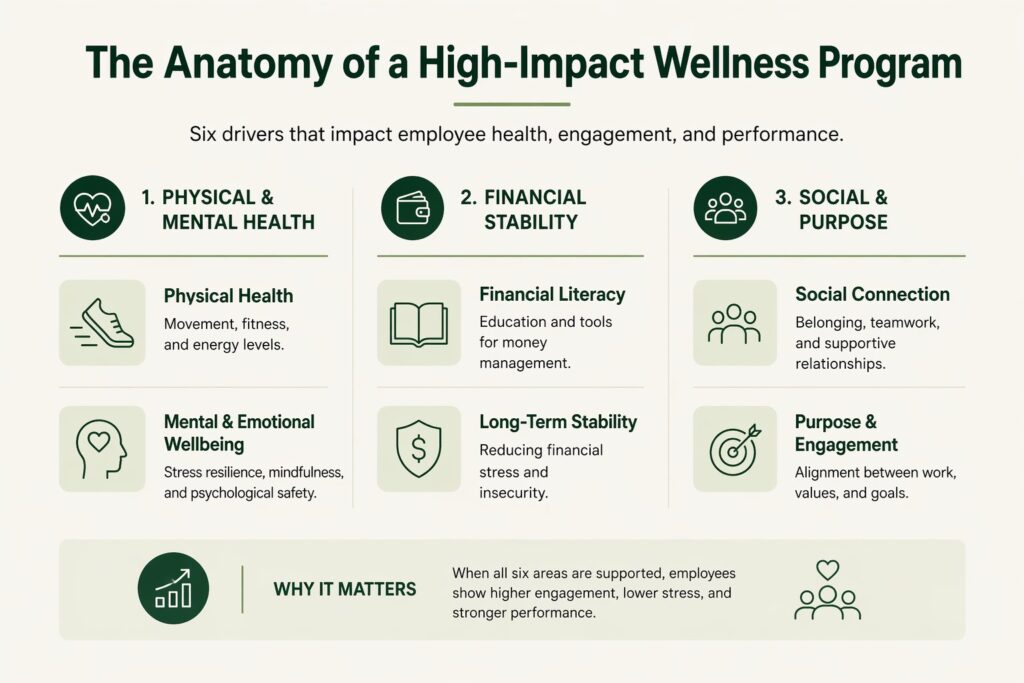
The Five Drivers of Performance
High-impact programs usually address multiple drivers at once:
- Physical recovery and strain management (including ergonomics)
- Mental wellbeing support
- Financial wellbeing
- Social connection
- Role clarity and workload structure
Coverage alone isn't enough.
The difference comes from three design choices:
- Workforce segmentation
Different employee groups require different solutions. - Manager involvement
Manager behavior directly affects participation and recovery. - Integration into work
Programs must fit into daily routines—not sit outside them.
Measuring What Actually Matters
Most wellness programs are measured incorrectly.
Activity metrics (attendance, sign-ups) show visibility—not value.
A stronger model includes three layers:
1. Activity
Participation and usage
2. Behavioral change
Adoption of better routines or support
3. Business outcomes
Absence trends, retention pressure, burnout signals
One of the clearest connections is absenteeism. Many organizations report reductions in sick days, which is easier to link to operational impact than abstract productivity claims.
From Intervention to Outcome
Every program should have a clear logic chain.
For example:
- Ergonomics = reduced discomfort = fewer interruptions = more consistent output
If that connection isn't clear, the program isn't ready for scale.
Board-level test:
If leadership can't explain how an initiative affects a business metric, it shouldn't be expanded.
Why Programs Fail in Practice
Most programs fail in execution, not intent.
Common issues include:
- One-size-fits-all design
- Weak manager support
- Poor communication of use cases
- Lack of trust around privacy
Availability is not the same as accessibility.
If employees can't realistically use a program—or don't trust it—they won't.
Choosing the Right Partner
Vendor selection often determines whether a program works.
The strongest partners don't just offer services. They help connect:
- Workforce need
- Intervention design
- Target population
- Measurable outcomes
Before selecting a partner, ask:
- Does this solve a real performance barrier?
- Can it be tailored to different employee groups?
- Does it connect to measurable outcomes?
- Does it integrate into existing workflows?
- Does it build trust with employees?
A broad offering isn't enough. It needs to be structured and measurable.
A Practical Roadmap for HR Leaders
To move from theory to results:
1. Audit current programs
Identify gaps between offerings and actual workforce needs
2. Define success upfront
Choose clear business outcomes (absence, retention, etc.)
3. Pilot a targeted solution
Start small with a clear hypothesis
4. Measure and adjust
Refine before scaling
Final Takeaway
Wellness programs don't automatically improve productivity.
Some deliver measurable impact. Others don't move the needle.
The difference comes down to:
- Targeting
- Design
- Manager support
- Measurement discipline
For leadership teams, the goal isn't to prove wellness works in general.
It's to build a version that works in your organization—and can be defended with evidence.
Excel Wellbeing Solutions helps organizations design workplace wellbeing strategies that connect employee support to measurable business outcomes.
For teams moving toward a more targeted approach, the focus should be on aligning workforce needs, program design, and performance metrics from the start.