
93% of employees now consider wellbeing support as important as salary, and the corporate wellness market is projected to grow from $70.4 billion in 2024 to over $106 billion by 2029 according to industry projections on corporate wellness growth and employee expectations. That changes the entire conversation around a corporate fitness program.
For a Fortune 500 HR leader, this isn't a side initiative for open enrollment season. It's a business system. It affects talent attraction, retention, health risk, morale, and the credibility of the employer brand. Companies that still treat fitness as a gym discount attached to a benefits portal are operating with an outdated model.
A modern corporate fitness program has to earn budget like any other enterprise investment. That means it must be designed around workforce needs, tied to measurable outcomes, supported by leadership, and evaluated with discipline. Anything less becomes another underused perk.
Beyond the Gym Pass: A New Definition of Corporate Fitness
The old model was simple. Buy access. Announce it. Hope employees use it.
That model underperforms because it confuses availability with behavior change. A gym membership can be useful, but by itself it doesn't solve sedentary work patterns, chronic stress, hybrid workforce fragmentation, or the fact that many employees won't engage with a fitness offering that feels inconvenient, intimidating, or irrelevant.
Corporate fitness is a workforce performance strategy
A serious corporate fitness program should be defined as a structured system that helps employees move more, recover better, manage stress, and build sustainable health habits inside the context of work. It should support people in offices, in field roles, and across hybrid schedules. It should offer options that meet different ability levels, privacy preferences, and cultural expectations.
That broader definition matters because enterprise leaders aren't buying classes. They're managing risk.
A well-designed program supports several business goals at once:
- Talent strategy: It signals that the organization treats wellbeing as part of the employee value proposition.
- Retention strategy: It gives employees practical support, not just rhetoric, around energy, stress, and resilience.
- Cost strategy: It helps reduce avoidable health-related costs and lost work time.
- Culture strategy: It creates visible habits that reinforce a healthier working environment.
A corporate fitness program should be judged the same way any executive initiative is judged. By whether it changes outcomes, not whether it looks good in a benefits brochure.
The new baseline is holistic and measurable
The right program doesn't revolve around one location or one activity. It combines physical activity with recovery, nutrition, and mental wellbeing support. It also creates a clear measurement model from day one.
That's the shift many companies still need to make. They don't need more perks. They need a fitness strategy that fits real work conditions, earns executive backing, and produces evidence that leadership can defend in budget season.
For enterprise HR teams, the practical question isn't whether to offer a corporate fitness program. It's whether the organization is willing to build one that functions like a core business capability instead of an optional extra.
The Strategic Business Case for a Wellness Program
Companies with effective health and wellbeing strategies do not treat fitness as a side benefit. They treat it as a cost-control and workforce-performance decision.
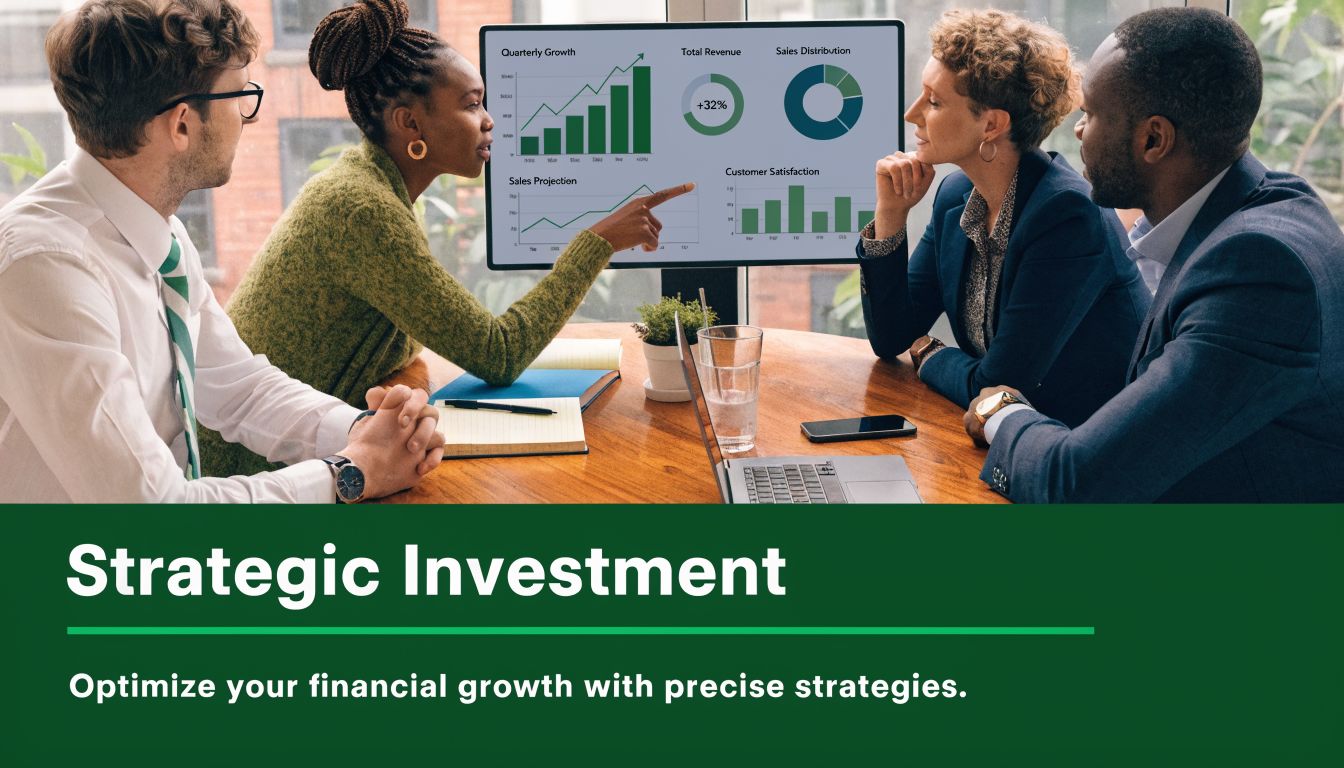
That distinction matters in the budget meeting. Finance leaders fund initiatives that reduce avoidable cost, protect output, and strengthen retention. A corporate fitness program earns funding when HR presents it as an operating strategy with clear metrics, ownership, and accountability.
The business case spans multiple P&L pressures
Too many organizations try to justify wellness through healthcare claims alone. That is weak positioning. The stronger case is cumulative and cross-functional.
A well-run program can improve performance in several areas at once:
- Absenteeism: Fewer health-related absences protect team capacity and reduce scheduling disruption.
- Productivity: Better energy, lower fatigue, and fewer preventable physical complaints support more consistent output.
- Retention: Employees stay longer when support is practical, visible, and relevant to daily work conditions.
- Healthcare trend management: Lower population risk helps control long-term claims pressure.
- Employer brand: A credible wellbeing strategy strengthens the employee value proposition in competitive hiring markets.
That is why the right executive framing matters. Use the language of risk, cost, and performance. This perspective on why corporate wellness programs are a business essential, not a luxury aligns with that standard. Unmanaged employee health risk becomes an operating issue, not a culture issue.
Enterprise leaders should judge the program like any other business investment
The wrong pitch focuses on good intentions. The right pitch focuses on measurable workforce outcomes.
For a CHRO, that means building the case around questions a CFO will respect:
- Where is the organization losing productive time because of preventable health and stress issues?
- Which workforce segments show the highest fatigue, musculoskeletal strain, or burnout risk?
- What does unplanned absence cost by function, location, or labor type?
- Which indicators can improve within 6 to 12 months if the program is designed well?
This is the difference between a perk and a business function. Perks are hard to defend when budgets tighten. Programs tied to productivity, retention, and cost control survive scrutiny.
Large employers have already shown the model can work
One widely cited example is Johnson & Johnson, whose long-running employee wellness effort is often referenced for delivering substantial savings over time. The exact number matters less than the operating principle. Large organizations get results when they commit to a sustained program, define what success looks like early, and measure outcomes over multiple years instead of chasing short-term participation spikes.
That is the standard to use.
Executive test: If the program can reduce avoidable absence, support workforce capacity, and slow health-related cost pressure, it belongs in strategic planning.
CFOs respond to disciplined logic. CHROs should present corporate fitness as a portfolio of workforce interventions tied to business outcomes, with baseline measures, review cycles, and clear ownership across HR, benefits, and leadership.
A weak business case says the company wants to support wellbeing. A strong business case says the company will use a structured fitness strategy to reduce avoidable cost, protect performance, and improve retention, then prove it with data.
The Four Pillars of a Holistic Corporate Fitness Program
A corporate fitness program earns budget when it addresses the full set of conditions that shape employee performance. Exercise matters, but it is only one part of the system. If your design ignores recovery, stress, and food habits, participation drops and business impact stays shallow.
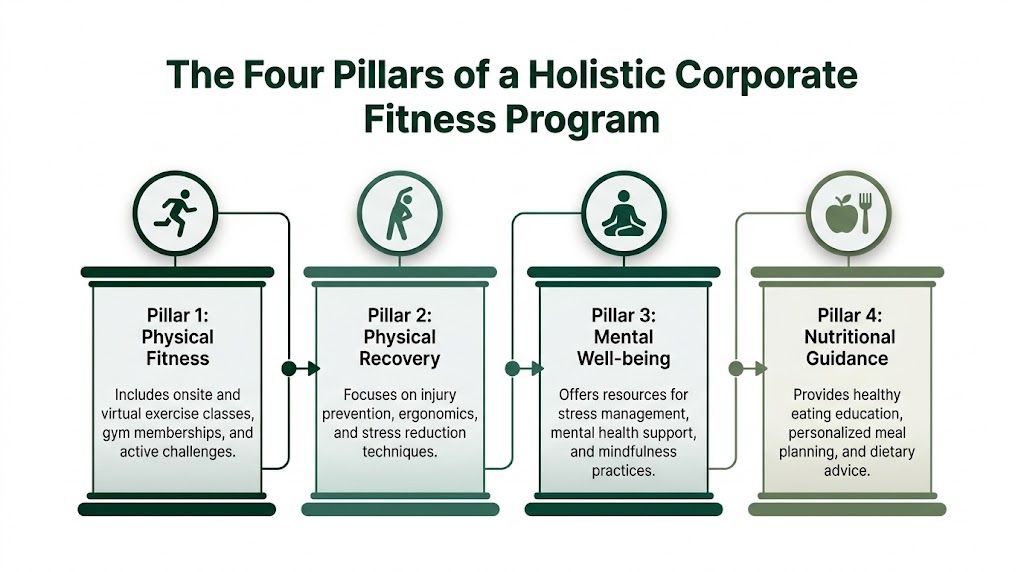
Enterprise leaders should build around four pillars that work together. That structure gives HR a practical framework for program design, vendor selection, and outcome measurement. It also makes executive conversations easier because each pillar maps to a business problem, not just an employee preference.
Physical fitness
This pillar drives visible engagement, but it must be built for real work conditions. Employees need options they can use during a normal day, not programming that assumes open calendars, high confidence, or prior training experience.
Offer a mix of onsite classes, virtual sessions, guided movement breaks, and team challenges. Keep formats short. Include beginner-friendly options. If an employee has to rearrange an entire schedule to participate, adoption will stall.
For employers considering onsite delivery, a well-designed gym at office program can remove access barriers and increase consistency.
Physical recovery
Recovery is the pillar many companies miss. It is also one of the fastest ways to reduce daily friction for desk-based teams, travelers, and employees doing repetitive physical work.
Include stretching sessions, mobility training, ergonomic education, and workplace massage therapy where appropriate. These services help employees feel better during the workday, which increases the odds that they will stay active and productive instead of managing avoidable discomfort.
Recovery support improves program usability.
Mental wellbeing
Stress directly affects attendance, focus, energy, and follow-through. Any fitness strategy that treats mental wellbeing as separate from physical activity will underperform.
This pillar should include practical support such as stress management workshops, resilience training, mindfulness resources, and manager education on workload pressure. Keep the content applied and work-relevant. The goal is to help employees regulate energy and sustain healthy routines under real operating pressure.
Nutritional guidance
Employees do not make food choices in ideal conditions. They make them between meetings, during travel, across shifts, and inside whatever food environment the company has created.
Good nutrition programming reflects that reality. Offer practical education, meal-planning support, and sessions focused on sustainable eating habits at work. Skip rigid advice. Give employees usable guidance they can apply in cafeterias, airports, home offices, and long meeting blocks.
What enterprise leaders should require
These four pillars do not need equal funding, but they do need deliberate design. A provider should be able to configure the program for different workforce groups and delivery models.
- Office-based populations: Group classes, recovery sessions, and nutrition education tied to the workday.
- Hybrid teams: Virtual training, digital support, and scheduling flexibility.
- High-stress functions: Movement programming paired with mental wellbeing support.
- Distributed workforces: Consistent standards across locations with local delivery where needed.
Excel Wellbeing Solutions is one example of a provider with services spanning onsite fitness classes, massage therapies, nutritional guidance, and mental health resources. That type of four-pillar model is far more useful than a single reimbursement or a narrow activity challenge.
Use this section as a design standard. If the program only serves employees who are already active, it will stay a perk. If it supports participation across fitness, recovery, nutrition, and mental wellbeing, it can function as a workforce strategy with measurable business value.
Your Implementation Roadmap From Concept to Launch
Most corporate fitness programs don't fail because employees dislike wellbeing. They fail because leadership launches activity before building infrastructure.
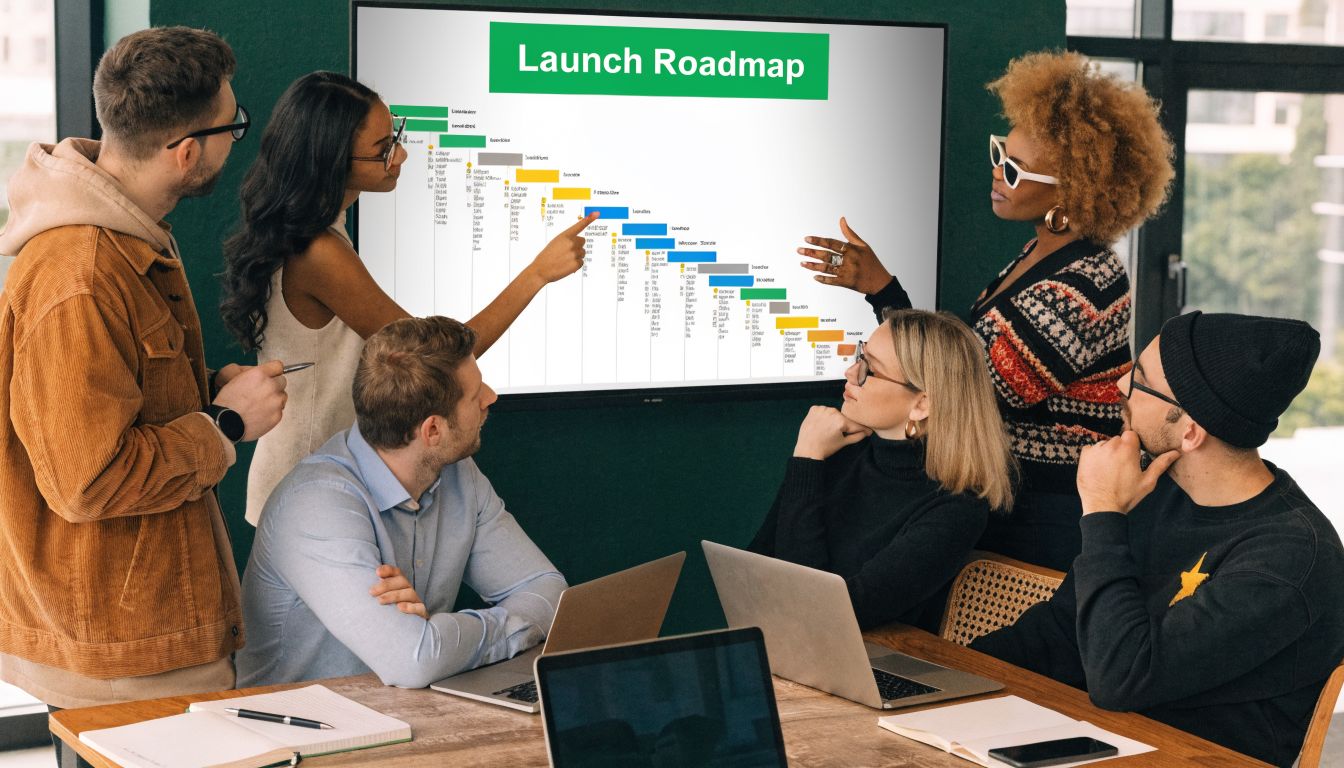
One warning deserves attention. Programs often fail without senior management commitment and when they don't address underlying work structures. Also, despite 87% of employees having access to mental health offerings, only 23% use them, according to reporting on implementation gaps and low utilization. Access alone doesn't create adoption.
Phase one needs assessment
Before selecting vendors or programming, HR should establish what the workforce needs. That means using available survey data, benefits data, attendance trends, workforce segmentation, and any existing health risk information that can be reviewed appropriately.
Leaders should ask practical questions:
- Where is the friction? Is the issue inactivity, stress, physical discomfort, low morale, or fragmented hybrid engagement?
- Who is being missed? Night-shift staff, remote employees, field teams, and employees new to exercise are often ignored.
- What blocks participation? Time pressure, leadership behavior, meeting overload, and lack of psychological safety matter more than branding.
If the organization wants onsite activation, it should also assess the physical environment. Space, changing facilities, scheduling windows, and building policies shape what's realistic. For organizations exploring onsite options, gym-at-office program considerations are part of the implementation conversation.
Phase two program design
Once workforce needs are clear, the program should be designed around outcomes, not amenities.
That means choosing a delivery mix with purpose. An office-heavy population may need onsite classes and recovery sessions. A global hybrid workforce may need virtual programming and modular scheduling. A high-pressure business unit may need movement options integrated with stress-management support.
A strong design usually includes:
- Core programming: Recurring activities people can build into routine.
- Flexible access: Options for location, schedule, and ability level.
- Manager enablement: Clear expectations that participation is supported, not penalized.
- Measurement plan: Defined metrics before launch, not after budget scrutiny starts.
Phase three vendor selection and launch discipline
A provider shouldn't be chosen because the proposal looks energetic. The provider should be able to align services, reporting, privacy handling, and workforce realities.
Launch also needs more than an announcement email. The organization should identify executive sponsors, manager champions, communication channels, and visible participation norms. Employees watch what leaders do more than what leaders say.
If leadership schedules back-to-back meetings all day and then promotes a wellness class at lunch, employees will read the culture correctly and ignore the invitation.
The final launch checklist should include executive sponsorship, manager talking points, calendar integration, accessibility review, and a practical enrollment path. A corporate fitness program succeeds when it fits the organization's operating model. If it fights the workday, utilization drops fast.
Measuring Success and Proving Program ROI
If leadership asks whether the corporate fitness program is working, participation screenshots won't be enough. A credible measurement model needs three layers: engagement, biometric evidence, and financial impact.
The most important discipline is this: track aggregate trends, not individual health stories. Effective programs monitor BMI, total cholesterol, blood pressure, fasting blood glucose, waist circumference, and resting heart rate, and those aggregate shifts provide HIPAA-compliant evidence for ROI and healthcare cost savings according to guidance on biometric tracking for corporate fitness programs.
Engagement metrics show whether the program is usable
Engagement data tells leadership whether employees are interacting with the program. This includes registration, attendance, repeat participation, challenge activity, and use across workforce segments.
Engagement is an early signal. It doesn't prove business value by itself, but it does show whether the offering is relevant, accessible, and well communicated. A company that ignores engagement data won't know whether weak outcomes come from poor design or poor execution.
For organizations that need centralized visibility, digital employee health and wellness platforms can support consistent tracking and reporting across onsite and distributed populations.
Biometric trends show whether behavior is changing
Biometric reporting matters because it moves the conversation beyond self-reported enthusiasm.
A pre-program baseline should be established, followed by periodic reassessment at the aggregate level. If the program is designed well and employees participate consistently, leadership should be able to see directional movement in the six core metrics over time. That gives HR a defensible story tied to health risk trends, not anecdotes from highly motivated participants.
Financial metrics connect health to business value
Many teams often get sloppy at this point. They collect activity data, then stop short of connecting it to cost.
A practical ROI dashboard should include:
- Absenteeism indicators: Trends in lost work time where available.
- Healthcare-related trends: Aggregate risk movement and claims-related signals, if the organization can review them appropriately.
- Turnover-related indicators: Retention trends in target populations when the program is part of a broader wellbeing strategy.
- Cost formulas: Clear methods leadership can audit.
| Measurement category | What it answers | What leadership should expect |
|---|---|---|
| Engagement | Are employees using the program? | Participation patterns, repeat use, adoption by segment |
| Biometrics | Are health risks moving? | Aggregate shifts in key indicators over time |
| Financials | Is the investment defensible? | Absenteeism, cost trends, and outcome-based ROI narrative |
A mature corporate fitness program doesn't rely on inspirational stories to survive budget review. It produces an evidence trail. That's what turns wellbeing from a cultural aspiration into an operational asset.
How to Choose the Right Corporate Wellness Partner
Most vendor evaluations focus on surface features. That's the wrong lens. The key question is whether the partner can operate inside enterprise complexity.
A corporate fitness program partner should be evaluated the same way any strategic service partner is evaluated. Can the provider customize delivery, support different employee populations, produce useful reporting, and work within the company's operating constraints? If the answer is vague, the program will drift.
Non-negotiable evaluation criteria
The fastest way to improve an RFP process is to stop asking broad questions such as “What's included?” and start asking operational questions that expose execution quality.
| Evaluation Category | Key Questions to Ask | Why It Matters |
|---|---|---|
| Program customization | Can the provider tailor programming to different workforces, schedules, and ability levels? | A generic package usually leaves major employee groups out. |
| Hybrid and onsite delivery | Can the provider support both physical locations and distributed teams without creating two separate experiences? | Enterprise workforces rarely fit one delivery model. |
| Reporting capability | Can the provider deliver aggregate engagement and outcome reporting that leadership can actually use? | If reporting is weak, budget defense becomes difficult. |
| Privacy and data handling | How does the provider handle aggregate data, confidentiality, and reporting boundaries? | HR needs evidence without exposing individual employee information. |
| Instructor quality | Who delivers the sessions, and how are they prepared to work with mixed fitness levels? | Poor facilitation kills trust and repeat participation. |
| Recovery and holistic support | Does the provider offer more than exercise alone? | Single-channel programs often miss the real drivers of disengagement. |
| Operational fit | Can the provider work with building constraints, security requirements, scheduling limits, and internal approvals? | Good ideas fail when they can't function inside the workplace. |
| Communication support | Can the provider help with launch messaging, manager enablement, and ongoing promotion? | Adoption depends on communication as much as content. |
Questions that separate serious partners from polished presenters
A capable HR leader should ask for specifics, not slogans.
- Ask for reporting examples: Leadership needs to see what an actual executive summary looks like.
- Ask how the provider adapts for low-confidence participants: Programs often over-serve people who already exercise.
- Ask about workforce segmentation: Different business units may need different formats.
- Ask what happens after launch: Many providers sell excitement upfront and deliver inconsistency later.
The right partner doesn't just provide sessions. The right partner helps the company run a repeatable system that leadership can measure and scale.
The strongest selection decisions usually come from cross-functional review. HR, benefits, facilities, and operations should all weigh in because each group sees a different failure point. A provider may look strong on programming but weak on logistics. Or polished on marketing but thin on measurement.
The goal isn't to buy the most expansive menu. It's to select a partner that can support the workforce the company has.
Securing Executive Buy-In and Driving Employee Adoption
Companies with strong wellbeing participation do not get there through enthusiasm alone. They get there by treating adoption as an operating metric and executive sponsorship as a business decision.
A well-rounded corporate fitness program fails fast when leadership support is vague or employee communication sounds like generic HR promotion. These are two separate jobs. The executive case must justify investment, accountability, and expected returns. The employee case must make participation feel relevant, easy, and acceptable during the workday.
Build the executive case like an investment proposal
Senior leaders respond to cost control, performance protection, and execution discipline. Present the program the same way you would present any workforce initiative competing for budget.
Use a simple financial model. Start with current absence levels, turnover in high-stress teams, healthcare trend data if available, and the cost of replacement for key roles. Then show how the program will be implemented, which participation targets matter, and how results will be reviewed. The American Heart Association's guidance on measuring workplace health impact supports this approach by tying program value to defined business metrics rather than vague engagement claims.
The message to the C-suite should be direct:
- Problem: preventable absence, stress-related productivity loss, and avoidable attrition carry real labor cost.
- Intervention: the program gives employees structured, usable support, not another underused benefit.
- Governance: HR will report participation, utilization patterns, and business indicators on a fixed cadence.
- Financial logic: success is judged against baseline data, not good intentions.
Executive messaging template
Use language like this in your leadership deck or approval memo:
We are proposing a workforce health initiative designed to improve participation in healthy routines, reduce avoidable absence, support retention, and measure results against baseline and post-launch workforce data. This will be managed as a business program with clear adoption targets, reporting cadence, and defined success measures.
That wording works because it signals discipline. Finance sees a measurement plan. Operations sees implementation control. HR keeps the conversation focused on outcomes instead of perks.
Employee adoption rises when the program feels usable
Employees participate when the first step is simple, the offer feels relevant, and managers clearly permit time and attention for it.
The launch message should answer three questions fast. Is this for me? How hard is it to start? Will anyone judge me for using it?
Weak communication talks about a new fitness benefit. Strong communication explains how an employee can join at any level, choose options that fit a real schedule, and participate without already being fit or confident. That shift matters because adoption problems usually come from friction and self-consciousness, not lack of awareness.
The communication system HR should run
Treat adoption as a campaign, not a launch email.
- Company-wide launch message: explain what is available, who it serves, and how to start in under two minutes.
- Manager brief: give people leaders a short script that normalizes participation during the workweek.
- First follow-up: focus on low-pressure entry points, short sessions, and beginner-friendly options.
- Ongoing updates: share aggregate participation and progress without turning the program into a public ranking exercise.
Manager behavior has outsized impact here. If employees believe participation will be read as time away from work, usage drops. If managers mention the program in team meetings, use it themselves, and respect calendar time for participation, adoption improves.
One recommendation: give executives and managers prewritten language instead of asking them to improvise. That removes inconsistency and keeps the program positioned as a performance support system.
A practical message for managers
Use a short internal note like this:
The company wants employees to use this program in ways that fit their workload and personal starting point. Participation is encouraged across all fitness levels. Managers should support reasonable use during the workweek and reinforce that this is part of how we support sustainable performance.
That message does two things. It grants permission. It also removes the stigma that only highly active employees belong in the program.
Credibility decides the outcome. Executives need a case they can defend in budget discussions. Employees need a program they can realistically use.
Excel Wellbeing Solutions helps organizations build workplace wellbeing programs that go beyond generic perks. For companies exploring a corporate fitness program with onsite fitness classes, massage therapy, nutrition support, and mental wellbeing resources, Excel Wellbeing Solutions is one option to evaluate as part of a broader enterprise wellbeing strategy.