
Digital employee health and wellness platforms stopped being a nice-to-have when finance teams started asking harder questions about healthcare spend, absenteeism, and retention. The reframing is simple. Organizations that invest well in wellness technology aren't just buying another employee perk. They're building infrastructure that can influence cost, productivity, and workforce stability.
The clearest reason the conversation has changed is ROI. Companies adopting digital employee health and wellness platforms see an average return of USD 1.50 to 3 per dollar spent over 2 to 9 years, and wellness programs generate USD 5.82 in absenteeism cost savings per dollar spent, according to employee wellness statistics compiled here. That changes the executive discussion immediately. The budget line starts to look less like discretionary spend and more like an operational advantage.
The New Imperative for Workforce Wellbeing
Hybrid work exposed a basic weakness in older wellness models. Onsite classes, occasional screenings, and fragmented benefits portals don't serve a distributed workforce well. Employees need support that travels with them across office days, home days, travel schedules, and irregular work hours.
That's why digital employee health and wellness platforms matter now. They give employers a way to deliver support consistently instead of hoping people remember which vendor handles which service. They also give leaders a way to manage wellbeing as a system rather than a patchwork of underused offerings.
Why leadership teams are paying attention
The strongest business case isn't philosophical. It's operational.
When a company can reduce avoidable absence, improve access to mental health support, and make benefits easier to use, the impact shows up in areas executives already track. That includes claims trends, productivity drag, voluntary turnover, and manager strain. In large organizations, even small shifts in those categories matter.
A digital platform also fits how people seek support. Employees often want privacy, convenience, and immediate access. They don't want to wait for a scheduled HR conversation to find a resource or figure out reimbursement rules.
Practical rule: If wellbeing support requires too many clicks, too much explanation, or too much courage to access, employees won't use it at the moment they need it.
Why old approaches fall short
Traditional wellness programs often fail for predictable reasons:
- They're fragmented. Mental health sits in one app, fitness in another, incentives in a third, and benefits details in a static portal.
- They're hard to measure. HR can count participation in a challenge, but can't connect that activity to broader workforce outcomes.
- They favor headquarters staff. Remote employees, field teams, and multi-location populations get a weaker experience.
- They launch loudly and then fade. Without a digital operating layer, momentum depends on manual reminders from HR.
The new imperative isn't to digitize every perk. It's to make wellbeing support visible, usable, secure, and measurable at enterprise scale.
Decoding the Digital Wellness Ecosystem
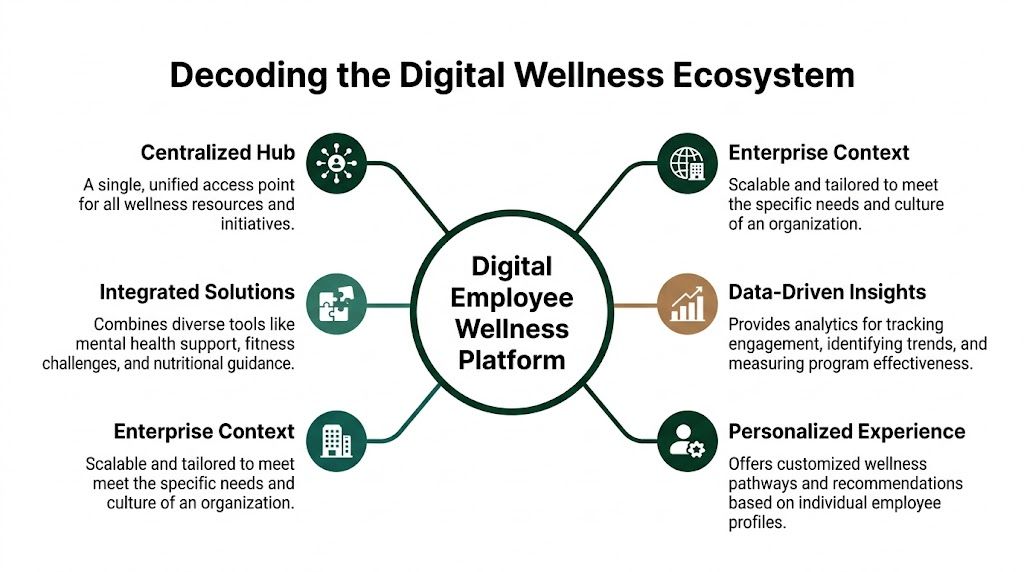
A digital employee health and wellness platform is best understood as a central operating layer for wellbeing. It isn't one feature and it isn't one campaign. It's the place where employees access programs, where administrators track engagement, and where leaders can finally see whether all those separate wellbeing investments are working together.
What the platform actually does
At the employee level, the platform acts like a single front door. Instead of asking people to access separate tools, logins, and enrollment paths, it brings core wellness resources into one experience.
That usually includes a mix of:
- Mental health support through guided content, coaching access, or digital tools
- Physical wellbeing programs such as activity tracking, movement challenges, and habit-building plans
- Nutrition and lifestyle resources that help employees translate health goals into daily routines
- Benefits-connected experiences such as incentives, reimbursements, or lifestyle account access
- Communications and campaigns that keep wellness visible throughout the year rather than during one annual push
Why ecosystem thinking matters
Many organizations buy point solutions because each one sounds useful in isolation. The problem starts later. Employees don't experience those offerings as a strategy. They experience them as clutter.
A strong platform fixes that by connecting the pieces. It can sync with wearables, pull in relevant HR data, organize campaigns by population, and give administrators one dashboard instead of several spreadsheets. The result is simpler governance and a cleaner employee experience.
The real value isn't having more wellness resources. It's giving employees one place to use them and giving HR one place to manage them.
The enterprise lens
In enterprise settings, the platform also becomes a coordination tool across teams that don't usually sit together. HR owns strategy. IT reviews integrations and access controls. Legal and privacy teams review data handling. Finance wants proof that the investment belongs in the total rewards portfolio.
That's why the best evaluation question isn't “What features are included?” It's “Can this system coordinate employee experience, data handling, reporting, and cross-functional ownership without adding administrative drag?”
A feature-rich platform that doesn't integrate cleanly or support enterprise governance usually becomes one more underused program. A simpler platform with solid workflows, usable reporting, and strong employee adoption often creates more value.
The Tangible Business Case for Digital Wellness
Employers with highly effective wellness programs report lower healthcare cost trends, less unplanned absence, and stronger employee engagement than peers with less effective programs, according to industry research from the Health Enhancement Research Organization, Mercer, and StayWell. That matters because enterprise buyers rarely lose budget approval over interest in wellbeing. They lose it when they cannot connect the investment to operating results, risk controls, and measurable adoption across regions.
A digital wellness platform earns its place in the budget as infrastructure for workforce performance. It helps large employers standardize access, reduce manual administration, and create reporting that stands up in finance review. The strategic question is not whether employees say they want wellbeing support. The question is whether the organization can deliver it in a way that is secure, integrated, globally usable, and measurable.

Where the business value actually shows up
In practice, the value shows up in a few places that finance and operations teams already care about.
Access is the first one. If employees can get to mental health support, coaching, preventive education, or benefits guidance without confusion, usage rises and avoidable escalation drops. That does not solve every health or retention problem, but it gives the company a better chance of addressing issues earlier.
Administrative efficiency is the second. In large organizations, HR teams often spend more time coordinating disconnected programs than improving outcomes. A single system can reduce manual reporting, vendor handoffs, and repeated employee questions. That matters when the People team is expected to support growth, compliance, and employee experience with limited headcount.
Measurement is the third, and it is the one that usually decides renewal. Digital platforms make it possible to track enrollment, active use, repeat engagement, population trends, and program reach by region or business unit. If the platform cannot produce usable reporting, the business case weakens fast.
For many leadership teams, the most credible framing is operational. Wellness spend should support workforce continuity, protect productivity, improve use of existing benefits, and reduce wasted administrative effort. That is the same logic behind why corporate wellness programs are a business essential not a luxury.
What resonates with a CFO and CIO
CFOs usually want a defensible model, not broad promises. CIOs want to know whether the platform adds risk to an already crowded HR tech stack. In enterprise settings, both stakeholders are right to push hard here.
A credible business case usually ties the purchase to existing pain points:
- Absence and productivity drag linked to stress, burnout, and delayed access to support
- Underused benefit spend because employees cannot find or trust the resources already available
- Manager time loss caused by informal escalation of issues that should route through defined support channels
- Fragmented reporting that makes it hard to assess outcomes across countries, business units, or employee groups
- Technology sprawl from adding another standalone wellness tool without HRIS, SSO, or benefits integration
Security and integration belong in the ROI conversation from the start. A platform that creates extra privacy reviews, duplicate employee records, or regional compliance concerns will drive up internal cost before it delivers any employee value. I have seen organizations approve a wellness budget, then lose six months in procurement because no one asked early enough about data residency, identity management, API maturity, or how reporting would work across different benefit structures.
If a platform cannot connect to enterprise systems, satisfy security review, and produce decision-ready reporting, it becomes an engagement experiment instead of a business asset.
What does not survive budget review
Feature volume rarely wins the argument. High participation in a launch month does not win it either.
What holds up is a narrower case built around execution. How quickly can the company deploy by region? What employee data is required, and who controls it? Can leaders segment reporting without exposing sensitive individual information? Can the vendor support local privacy requirements and language needs? What baseline metrics will be used to judge progress after 6 and 12 months?
The strongest buyers also pressure-test attribution. A wellness platform can contribute to lower absence, better retention, and stronger benefit use, but those outcomes are influenced by manager quality, workload, plan design, and local labor conditions. Mature teams acknowledge that complexity and still set measurable goals. They track adoption, reach, benefit utilization, employee sentiment, and operational efficiency, then evaluate whether those signals move in the right direction over time.
That is the business case. Clear use cases, controlled implementation risk, and evidence the platform can create value across a global workforce.
Essential Components of a Modern Wellness Platform
A modern wellness platform earns its place by serving two groups at once. Employees need support they will use. HR, IT, legal, and finance need controls, reporting, and governance that hold up across regions, worker types, and benefit structures.
That balance is harder than it looks.
Many platforms can generate launch activity. Far fewer can handle the operational realities of an enterprise rollout, especially when mental health support, reimbursement workflows, privacy expectations, and executive reporting all sit in the same system. The right evaluation standard is not feature volume. It is whether the platform can produce sustained participation, clean administration, and evidence of business value.
Mental health support with privacy built in
Mental health support needs low-friction access and clear privacy boundaries. If employees have to ask a manager where to start, sort through multiple portals, or worry that use will be visible to the company, engagement falls fast.
The better platforms reduce that friction. They offer direct access, private self-service entry points, and clear explanations of what the employer can and cannot see. That matters in every market, but it becomes even more important in global organizations where stigma, local care norms, and legal requirements differ by country.
Look for three capabilities:
- Immediate access to support, guidance, or triage without relying on business hours
- Confidential user journeys that separate personal use from employer-level reporting
- Personalized recommendations based on stated needs, eligibility, language, or prior activity
A practical test is simple. Ask the vendor to walk through the employee experience for someone who needs help at 10 p.m., on a mobile device, in a second language, and does not want their manager involved.
Physical wellbeing that supports sustained behavior, not short campaigns
Physical wellbeing still matters, but employees do not need another platform built around a one-month challenge and a leaderboard. They need tools that fit real schedules, uneven motivation, and different job conditions.
A stronger platform supports ongoing routines through device sync, habit tracking, recovery or sleep inputs, movement prompts, and structured programs that work for desk-based employees, field teams, and shift workers. The goal is consistency. If the experience only makes sense during a company campaign, utilization drops after launch and the data becomes less useful.
This is also where enterprise buyers should check for inclusion gaps. A program designed around office workers with wearables can miss manufacturing teams, frontline staff, or employees in countries where device adoption is lower.
Financial wellbeing and flexible benefit delivery
Wellbeing programs work better when they reflect how employees experience stress. Money, workload, caregiving, health, and time constraints show up together.
That is why many employers now want platforms that connect wellbeing support to broader benefit administration. In practice, that can mean reimbursement management, lifestyle spending accounts, regional benefit variations, or configurable program rules by population. A platform tied to a broader corporate wellness solution for enterprise teams is often easier to govern than a standalone app that sits outside the rest of total rewards.
The trade-off is complexity. The more flexible the model, the more important eligibility logic, policy controls, and reporting discipline become. If those controls are weak, HR ends up running manual exceptions and finance loses confidence in the spend.
Analytics that support decisions
Participation data alone does not help a CHRO or CFO make a case for renewal.
The platform needs to show patterns that can guide action. That includes repeat engagement, use by population, completion of key programs, referral or escalation trends, benefit utilization where relevant, and changes in sentiment or self-reported wellbeing over time. Reporting also needs thresholds and permission controls that protect confidentiality while still giving leaders useful insight.
Good analytics answer operational questions, not just marketing ones. Which populations are under-engaged? Which offerings hold attention after the first month? Where does communication fail by region, language, or worker type? Which features create administrative burden without improving outcomes?
That is the standard to use here. The best platforms do more than collect activity. They help the business decide what to keep, what to fix, and what is not delivering enough value to justify another year of budget.
Selecting Your Enterprise Wellness Platform
Deloitte reports that employee wellbeing remains a top workforce priority for executives, yet many companies still buy wellness technology with weak criteria and vague success measures. That is how teams end up with a polished app, a long implementation cycle, and no clear line to business value.
Selection needs to start with enterprise risk and operational fit. User experience matters, but it should not outrank privacy controls, integration requirements, reporting discipline, and the vendor's ability to support a global workforce under real conditions.
The first priority is data handling. A wellness platform may present employers with aggregated reporting, but the underlying workflows can still involve sensitive health, behavioral, demographic, or claims-adjacent information. The right review standard includes documented security controls, privacy policies, role-based access, data retention rules, cross-border processing terms, and clear thresholds for aggregate reporting. Guidance from the U.S. Department of Health and Human Services on de-identification is a useful benchmark for evaluating how vendors reduce re-identification risk in employer reporting.
The questions that actually matter
A sound procurement process tests whether the platform will hold up after launch, not whether the demo feels polished.
Ask vendors:
- What employee data is collected, where is it stored, and which teams can access it?
- What privacy thresholds govern employer reporting, and how do you prevent small-group identification?
- Which integrations are already supported for HRIS, identity, benefits, payroll, and communications systems?
- What requires custom work, internal IT support, or middleware?
- How are permissions set for HR, managers, regional leaders, and executives?
- What implementation work sits with the vendor, and what work shifts back to HR, IT, legal, and payroll?
- How do you support regional differences in language, content, incentives, and privacy obligations?
- What proof can you provide that the platform improves outcomes the business cares about, not just logins and challenge completions?
Security review should shape the shortlist early. If a vendor cannot answer basic questions about architecture, subcontractors, retention, and administrative access, the process is already off track.
Enterprise Wellness Platform Vendor Evaluation Checklist
| Evaluation Criterion | Key Questions to Ask | Weighting |
|---|---|---|
| Security and privacy | Which compliance standards are documented, how is data de-identified, and what are the rules for aggregate reporting? | High |
| Integration architecture | Which systems connect out of the box, what needs custom configuration, and how are identity and eligibility handled? | High |
| Reporting quality | Can HR measure engagement, trend lines, and business outcomes without manual data stitching? | High |
| Employee experience | Is the experience simple for office, remote, field, and international employees? | High |
| Global scalability | Can the platform support different regions, access conditions, and local operating realities? | High |
| Configuration and governance | Can the employer adjust programs, permissions, and communications without vendor support for every change? | Medium |
| Implementation support | Who owns onboarding, change management, testing, and post-launch optimization? | Medium |
| Vendor fit | Does the vendor understand enterprise procurement, privacy review, and cross-functional decision-making? | Medium |
| Incentive administration | Can the system support rewards or reimbursement processes cleanly? | Low |
| Visual polish | Is the interface modern and intuitive? | Low |
A broader wellness corporate solution for enterprise teams can help buyers evaluate the full operating model, not just the app interface.
The global scalability issue most teams miss
Global deployment is where weak vendors get exposed. A platform that works for headquarters employees on managed devices can struggle with multilingual communication, lower-bandwidth environments, local privacy rules, and different norms around mental health, coaching, or incentives.
I advise teams to ask a blunt question here. Can this platform perform across regions without creating manual workarounds for HR, payroll, legal, and local business partners? If the answer depends on custom exceptions in every market, costs rise quickly and reporting loses consistency.
The World Health Organization has also noted that digital health programs need to account for local infrastructure, access, and governance conditions. That matters in wellness procurement. Global enterprises should press vendors on content localization, mobile performance, support coverage, country-level compliance, and how outcomes are validated across different employee populations.
Your Roadmap for Integration and Adoption
Buying the platform is the easy part. Getting employees to use it consistently is where most programs either mature or stall.
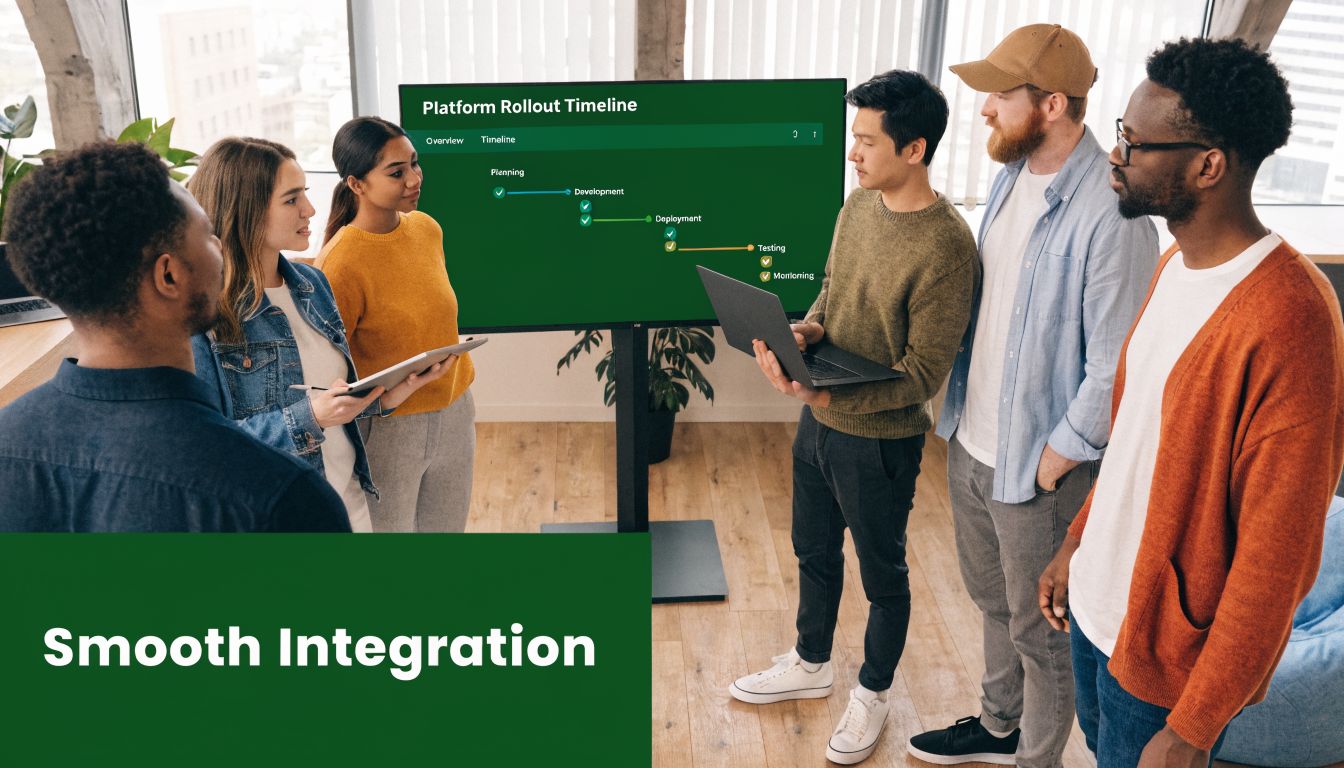
The best rollouts are phased, cross-functional, and boring in the right ways. They include testing, governance, communications, manager readiness, and measurement from day one. They don't rely on launch-week excitement to carry adoption for the rest of the year.
Phase one builds trust
Start with technical integration and a controlled pilot. This phase should confirm eligibility rules, data flows, access methods, reporting outputs, and privacy controls before the full population sees the platform.
A pilot group should be broad enough to expose real friction. Include remote employees, managers, different business units, and if relevant, international populations. If the platform only works smoothly for headquarters staff, the launch plan needs work.
A useful early checklist includes:
- Access testing across mobile, desktop, and identity systems
- Eligibility validation so the right populations see the right programs
- Content review for tone, clarity, and regional suitability
- Reporting checks to ensure leadership metrics are available from the start
Phase two creates organizational pull
Adoption rises when leadership treats wellbeing as part of operating discipline, not optional participation theater. Senior leaders don't need to overshare personal details. They do need to signal that using the platform is normal, supported, and aligned with company priorities.
Manager enablement matters just as much. Managers influence whether employees believe they have time and permission to engage.
A wellness launch fails quietly when leaders endorse it in theory but run teams in ways that make participation feel risky.
Champion networks can also help. Local advocates in offices, business units, and employee communities surface practical barriers faster than formal surveys do.
Phase three keeps the program alive
The common mistake is “launch and forget.” A platform needs a content and engagement rhythm. That can include campaigns tied to seasonality, benefits milestones, workload pressure points, or specific employee needs.
Communications should be short, relevant, and behavior-based. One message might introduce mental health resources. Another might prompt employees to complete onboarding. Another could target managers with a reminder about supporting team participation.
For organizations that want a lighter operational lift, starting small with health and wellness programs for employees that actually work is a practical model for sequencing rollout rather than trying to launch everything at once.
Where services need both digital access and human delivery, a provider such as Excel Wellbeing Solutions can support online scheduling, virtual wellness services, and hybrid-friendly program access as part of a broader implementation approach.
Measuring Success and Proving ROI
A platform only keeps executive support if HR can show what changed. That means building a measurement model before launch, not months later when someone asks whether the spend was worth it.
The most useful approach separates leading indicators from lagging indicators. Leading indicators show whether the program is gaining traction. Lagging indicators show whether that traction is affecting business outcomes over time.
Leading indicators to monitor early
These metrics help teams understand adoption quality, not just reach.
Examples include:
- Enrollment and activation by location, function, and employee group
- Repeat engagement rather than one-time logins
- Completion patterns for assessments, journeys, or campaigns
- Manager participation signals where leadership visibility matters
- Resource mix showing which offerings employees use most often
Leading indicators matter because they explain future results. If employees aren't returning to the platform or if engagement is concentrated in one employee segment, lagging outcomes will disappoint.
Lagging indicators that matter to executives
These measures take longer to move, but they're what executive teams care about most:
| KPI category | What to examine |
|---|---|
| Healthcare trends | Changes in claims patterns, preventive utilization, or cost pressure over time |
| Absenteeism | Whether avoidable absence is stabilizing or improving |
| Retention | Whether employee groups with stronger engagement show better stay patterns |
| Productivity signals | Whether teams report fewer wellbeing-related disruptions and better sustained performance |
| Benefits efficiency | Whether existing wellness and wellbeing investments are being used more consistently |
Build the story, not just the dashboard
A dashboard alone rarely persuades anyone. Leadership needs interpretation.
That narrative should answer four questions:
- Who engaged?
- What did they use?
- What changed operationally?
- What should the company do next?
A credible ROI story also acknowledges limits. Some outcomes move slowly. Some populations need personalized programming. Some engagement tactics work in one business unit and fall flat in another. That honesty improves trust.
Finance teams don't expect perfect causation. They do expect disciplined measurement, clean assumptions, and a clear recommendation for what happens next.
When HR presents wellness data with that level of rigor, the platform stops looking like a soft initiative and starts looking like a managed business program.
Next Steps for HR and People Leaders
Most organizations don't need more wellness options. They need a clearer operating model.
Digital employee health and wellness platforms work when leaders treat them as enterprise systems with employee-facing value, not as standalone engagement campaigns. The decision isn't merely whether to modernize wellbeing support. Instead, it's whether the company will do it in a way that protects data, fits the tech stack, reaches a distributed workforce, and produces evidence the C-suite will respect.
A practical three-step start
Build the right buying group. HR shouldn't evaluate this alone. Include IT, legal, privacy, finance, internal communications, and if the workforce is global, regional stakeholders who can challenge assumptions early.
Define success before talking to vendors. Some organizations need stronger mental health access. Others need a better way to unify fragmented offerings. Others need cleaner reporting for finance and leadership. A platform should solve a business problem, not just add features.
Shortlist with discipline. Use enterprise criteria first. Security, anonymized reporting, integration fit, implementation support, employee usability, and global scalability should narrow the field before anyone gets excited about interface details.
The clearest decision filter
A useful final test is simple. Would this platform still look like a good investment if employee engagement took time to build?
If the answer is yes because the data model is strong, the rollout plan is realistic, and the business case is measurable, the organization is likely evaluating the right solution. If the answer depends on perfect adoption and flawless enthusiasm, the model is too fragile.
The strongest wellness strategies are rarely flashy. They are structured, cross-functional, privacy-conscious, and tied to workforce outcomes leaders already care about.
Excel Wellbeing Solutions helps employers turn wellness strategy into a practical operating model through workplace and virtual wellbeing services that support hybrid teams, employee participation, and easier program coordination. Teams exploring a more integrated approach can learn more at Excel Wellbeing Solutions.