
U.S. gym memberships increased by 3.7% in 2023 to 68.9 million, surpassing 2019 levels, and facility usage rose 8.1% from 2022 to 2023, according to the Health & Fitness Association data summarized by Corporate Fitness Works. That matters for any executive evaluating a gym at office strategy. Employees are already returning to in-person fitness. The companies getting this right aren't treating the gym as a decorative amenity.
They're treating it like infrastructure.
A successful gym at office program isn't built by ordering a few machines, assigning an empty room, and hoping culture fills in the gaps. It takes demand planning, operating rules, staffing, programming, and a way to prove value after launch. It also takes honesty about trade-offs. Some workforces need a compact studio, not a full facility. Some need virtual access because hybrid schedules reduce on-site consistency. Some don't need more equipment at all. They need incentives, recovery space, screenings, and better program management.
The strongest office fitness projects are designed like any other enterprise investment. They start with workforce behavior, align with the property footprint, and connect directly to engagement, absenteeism, productivity, and retention. When the operating model is thoughtful, the facility becomes part of the workday instead of a neglected side room.
This 7-step playbook is built for leaders making a serious decision. It focuses on how to launch, what to avoid, and where office gyms usually succeed or fail.
1. Step 1: Plan the Compact Multi-Functional Fitness Studio
A compact studio is the right first move for many employers because it solves the hardest launch problem early. It gives employees a usable fitness space without forcing leadership into the cost, staffing, and utilization burden of a full-scale facility.
The planning standard is simple. The room should support strength training, cardio, and open-floor movement in one footprint. In practice, that usually means adjustable dumbbells, benches, kettlebells, resistance bands, one functional trainer or cable station, a small number of cardio units, durable flooring, and clear floor space for mobility work or coached sessions. Specialized machines often look impressive during a walkthrough and then sit idle for months.
Start with use patterns, not equipment catalogs
Studio planning should begin with how employees will use the room across a normal workweek. In office settings, participation usually clusters before work, at lunch, and shortly after the day ends. That has direct implications for the build. Access control, showers, lockers, sightlines, and a layout that keeps traffic flowing often matter more than adding another machine.
I advise leadership teams to answer four operational questions before they approve a purchase list. Who is the room for: beginners, regular exercisers, or a mixed population? Will people train alone, in pairs, or in small coached groups? What is the realistic peak occupancy? How quickly can the room turn over between users? Those answers shape the room more reliably than a vendor package.
A practical equipment mix usually falls into three categories:
- Strength basics: Dumbbells, benches, bands, and kettlebells cover the widest range of employee needs.
- Low-barrier cardio: Bikes, treadmills, or rowers support short sessions that fit around meetings.
- Functional floor space: Mats, mirrors, and open space make stretching, circuits, mobility, and instruction possible.
This is also where executives need discipline.
A strong studio is not just an equipment decision. It is an operating model. Booking rules prevent crowding during peak periods. Cleaning standards reduce friction between users. Preventive maintenance checks lower safety risk and protect the budget from avoidable replacement costs. If the room cannot be managed easily, adoption usually falls after the first burst of interest.
Practical rule: Buy for versatility first. Expand only after usage data justifies it.
Programming should be planned at the same time as the room. A studio gets far more use when employees have access to group and personal training services that show them what to do, how to progress, and how to use the space safely. Without that layer, companies often end up with an attractive room that photographs well, underperforms in practice, and struggles to show measurable value.
2. Step 2: Build a Hybrid On-Site and Virtual Program
A gym at office serves only the employees who can reach it unless the program is built for the way people work.
Hybrid work changed participation patterns, scheduling needs, and the definition of access. Some employees are in the office five days a week. Some come in twice. Some split time across client sites, home offices, and travel. A usable program has to cover all three groups without creating two separate wellness experiences.
Blend live coaching with remote access people will actually use
The practical model is simple. Keep a visible on-site schedule that gives office days energy and structure. Add virtual options that support remote days, travel weeks, and employees who are not ready to join a live class in person.
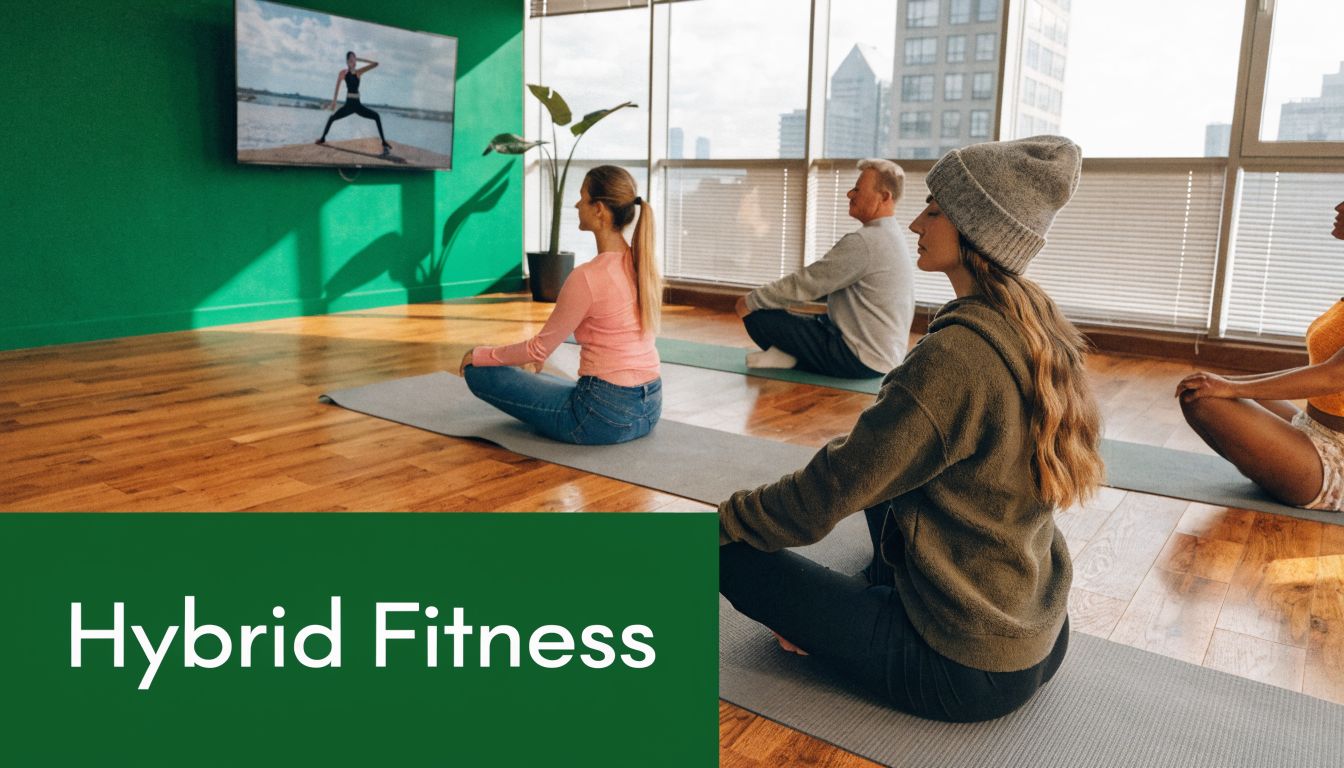
That usually means a mix of studio sessions, livestream classes, and a small on-demand library organized by goal and time. Yoga before work, a 20-minute lunch mobility session, and short strength or stretch sessions employees can pull up from home covers far more real-world use cases than a class calendar alone.
In practice, virtual access tends to support facility use rather than replace it. Employees who build consistency at home are often more willing to join an in-person session once they know the format, the instructor, and the time commitment. That is the trade-off executives should plan around. Convenience expands reach, but only if the remote offer stays connected to the on-site program.
Ownership matters here.
Hybrid programs lose momentum fast when nobody owns the calendar, registration process, instructor coordination, and employee communication. In smaller companies, that owner may sit in HR, people operations, or facilities. In larger organizations, it may be a wellness lead or a cross-functional team. The title matters less than the accountability.
A workable weekly structure often includes:
- Anchor sessions on-site: Recurring classes at the same times each week create habit and make participation easier to plan around.
- Short virtual formats: Fifteen to thirty minute sessions fit better between meetings and work well for remote employees.
- Travel and recovery content: Mobility, stretching, and low-impact sessions stay relevant even when employees are away from the office or returning from a busy period.
- Clear booking and replay rules: Employees need to know what is live, what is recorded, how to register, and how long content stays available.
The operating mistake I see most often is overbuilding the content library and underbuilding the cadence. A folder full of recorded workouts is not a program. Employees use digital wellness tools when there is a visible schedule, repeated communication, and live touchpoints that keep the offer current.
Start with a narrow format mix and run it well. Track sign-ups, attendance, replay views, and time-slot performance for at least one full quarter. Then adjust based on actual usage by employee segment, not on assumptions from leadership or vendor sales pitches.
A hybrid model works when it gives employees one wellness system with multiple access points. That is how companies extend participation beyond the building, protect the value of the physical studio, and build a program that can scale with the organization.
3. Step 3: Launch a Wellness Challenge and Incentive Program
A common launch pattern in workplace wellness is simple: interest spikes in week one, then attendance settles unless the company gives employees a reason to return. That is why the challenge and incentive layer matters. It is the operating system for behavior change, not a side campaign.

The companies that get traction here do not treat incentives as prizes for signing up. They reward repeat actions. That can include attending a set number of sessions, completing weekly movement goals, joining recovery or mindfulness activities, or checking in consistently over a defined period.
I usually advise leadership teams to treat early participation in the 20% to 30% range as a practical benchmark, not a failure. For a new office gym program, that is often enough to build visible momentum, generate peer proof, and identify which formats deserve more investment. Chasing mass participation in the first month usually leads to bloated prize pools, weak rules, and a program that is expensive to run but hard to sustain.
Challenge design needs range, because your workforce will not engage in the same way. A sound structure often includes:
- Multiple ways to qualify: Steps, strength sessions, mobility work, recovery visits, and mindfulness minutes widen access beyond experienced exercisers.
- Team-based scoring: Department, location, or cross-functional teams create accountability without pushing employees to share private health details.
- Weekly visibility: Scoreboard updates, manager prompts, and short employee stories keep the challenge present after the launch week.
- Tiered rewards: Small milestone rewards often work better than one large winner-take-all prize.
The trade-off is fairness versus simplicity. If rules are too loose, employees question the results. If rules are too strict, participation drops because the process feels like admin work.
Keep submission and tracking light. Employees should be able to log activity in less than a minute. If participation requires a special wearable, lengthy approvals, or manual proof for every action, adoption will stall. Use an honor-system model where possible, then audit lightly if abuse becomes a pattern.
Competition also needs guardrails. A mileage race may motivate your strongest fitness cohort and discourage everyone else. A points model is usually more durable because it lets different activities carry value. Someone recovering from injury should still be able to contribute through stretching, walking, or guided recovery sessions.
One rule belongs in every rollout: keep manager visibility limited to team-level participation trends unless employees choose to share more. Wellness programs lose trust fast when staff believe personal activity data could affect performance perception.
The strongest incentive program does three jobs at once. It drives repeat use of the gym, gives less active employees an easy entry point, and gives leadership a clean set of signals to review after the first quarter. Track participation rate, repeat participation, challenge completion, and cost per active participant. Those numbers help you decide whether to expand rewards, adjust the scoring model, or simplify the program before enthusiasm fades.
4. Step 4: Designate Wellness Rooms with Recovery Equipment
A gym at office shouldn't be limited to exertion. Recovery space is often what makes the facility usable across a wider employee population.
Not every employee wants to lift, run, or join a class. Many will use a quiet stretch area, guided recovery space, or massage chair room more consistently than the main training floor. That matters because broad utilization strengthens the business case for wellness real estate.
Separate recovery from activity
The most effective layout places recovery in its own room or clearly defined zone. That physical separation changes behavior. Employees can decompress without feeling like they're standing inside someone else's workout.
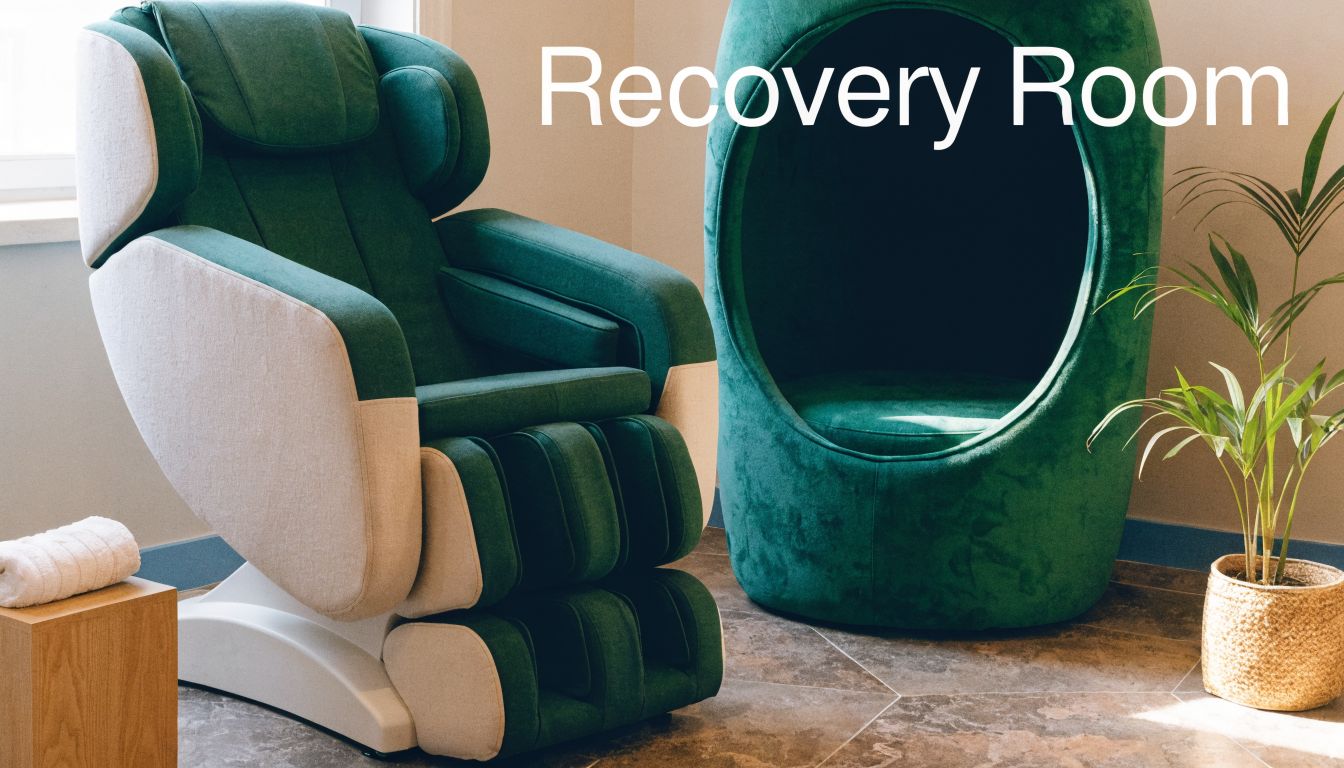
This space doesn't have to start large. A well-designed room with recliners or massage chairs, mats, foam rollers, soft lighting, and strong sanitation routines can add more practical value than another cardio machine. Booking controls also matter. If one person occupies a recovery room for an hour every afternoon, the rest of the workforce will write the amenity off as unavailable.
Corporate leaders should be especially careful with noise, lighting, and sensory load. Not every employee experiences a fitness environment the same way. The verified research brief on neurodiverse employees and office gyms highlights an underserved issue: many organizations still overlook sensory-friendly design when planning workplace fitness spaces. The operational takeaway is clear even without leaning on every detail in that brief. Quieter zones, lower stimulation, and equipment choices that don't create constant vibration or noise can widen access.
Small design choices shape usage
A few practical choices usually make the difference:
- Calming finishes: Soft lighting, plants, and natural materials lower the institutional feel.
- Short reservations: Brief booking windows help more employees access the space.
- Simple instructions: Clear signage reduces misuse of recovery tools.
Recovery rooms also support executives and high-intensity teams who may not have time for a full session but can use a short reset during the day. That has cultural value. It signals that wellness isn't only for employees who arrive before dawn in workout gear.
What doesn't work is turning a leftover conference room into a cluttered "wellness" area without privacy, cleaning supplies, or booking rules. Employees can tell when a space was designed for appearance rather than use.
5. Step 5: Integrate Preventative Health and Biometric Screenings
The gym becomes more valuable when it's connected to health data employees can use.
A standalone fitness room may improve convenience, but screenings and health assessments make the broader wellness strategy more targeted. They help employees understand risk, establish a baseline, and connect exercise behavior to practical next steps.
Give employees context, privacy, and follow-through
Screenings should never feel like a compliance exercise. Employees need to know what is being measured, why it matters, who sees the information, and what support comes next. Results should be shared with the employee and an appropriate health professional or coach, not circulated through management channels.
Many employers miss the point. They host a screening event, distribute results, and stop. No coaching. No next action. No integration with the office gym, class schedule, or benefits education. That turns a potentially useful service into a one-day event.
The stronger model links assessment findings with practical interventions. An employee who wants to improve cardiovascular fitness can be directed into beginner cardio programming. Someone dealing with stress and poor sleep may be steered toward mindfulness sessions, recovery options, or lower-intensity movement first.
A useful pre-launch tool exists for understanding exercise behavior inside office environments. A global study on office exercise behavior determinants identified 18 determinants across individual and socio-environmental factors and developed the Office Exercise Behavior Determinants Scale to measure barriers such as lack of time and inadequate facilities. Even if an organization doesn't deploy that exact instrument, the lesson is practical. Before building, leadership should diagnose what blocks participation.
Operational insight: Assess before prescribing. Otherwise the gym solves the problem leadership imagines, not the one employees face.
Screenings also support executive reporting. They create a baseline against which participation and behavior change can be interpreted more thoughtfully. Without a baseline, leadership often defaults to the weakest possible metric, which is limited to whether the room looks busy.
What doesn't work is any screening model that feels punitive, mandatory in tone, or disconnected from supportive resources.
6. Step 6: Prioritize a Mindfulness and Mental Health Program
Physical training gets the attention. Mental recovery determines whether the program fits modern work.
A gym at office that ignores stress, burnout, and cognitive overload is incomplete. Many employees don't need another competitive challenge first. They need a pathway back to basic regulation, better recovery, and sustainable energy during the workday.
Make mental wellness part of the operating model
The workforce context is hard to ignore. The verified research brief used for this project frames an underserved angle around hybrid work and wellness program ROI, noting that the broader conversation often misses how workplace wellness has to adapt to changing work patterns. For executives, the practical takeaway is straightforward. Mental health programming can't sit outside the fitness strategy as an optional add-on.
The most effective design includes several access points. Guided meditation. Breathwork sessions. Quiet spaces. Manager education. Supportive referrals. Clear communication that using these resources won't create stigma.
A mindfulness program also works better when it's scheduled like any other enterprise service. Calendar invites, recurring sessions, protected rooms, and credible facilitators matter. If the company says mental health is important but leaves employees to search for resources on their own, usage stays low.
Leaders often get one thing wrong here. They over-index on content and under-invest in normalization. A workshop alone won't shift behavior. Managers have to understand burnout signals. Teams need permission structures around breaks and recovery. Private booking systems need to protect confidentiality.
A practical mental wellness layer for a gym at office environment often includes:
- Guided sessions: Meditation or breathwork before work, midday, or late afternoon.
- Private access points: Rooms or virtual options for employees who don't want group participation.
- Professional support: Programs should connect to qualified experts, not informal peer advice.
For companies that want a structured path, meditation and mindfulness services can help integrate mental recovery into the daily rhythm of the workplace.
What doesn't work is treating mindfulness as branding. Employees respond when the offering is private, credible, and easy to access.
7. Step 7: Evaluate Corporate Wellness Partnerships
A workforce spread across multiple offices rarely gets equal value from a single on-site gym. Partnership strategy matters because access, adoption, and administrative control tend to break down first in distributed organizations, not in the fitness room itself.
For many employers, the better model is a managed mix of limited on-site space and external wellness access. That approach works well for regional teams, hybrid schedules, travel-heavy roles, and offices where real estate costs make expansion hard to justify. A gym at office program can still anchor the culture, but the delivery model has to match how employees work.
The decision is operational before it is aspirational. Start with headcount concentration, office attendance patterns, commuting radius, and the likely weekly usage by location. A dense headquarters with predictable traffic may support a dedicated studio. A workforce split across cities usually gets better coverage from a partnership model with clear eligibility rules, reimbursement logic, and reporting standards.
The business case should also be judged with discipline. Earlier research cited in this article shows wellness investment can produce measurable returns, but those averages are not budgeting assumptions. I advise executives to model their own version of ROI using three categories: participation, health risk reduction, and productivity impact. If a partner cannot provide usable utilization data, implementation support, and a practical rollout plan, the program will be hard to defend after year one.
Partnerships also need governance. External access placed quietly in the benefits portal usually underperforms because employees miss enrollment windows, managers do not reinforce the offering, and HR cannot see what is getting used. Set ownership early. Someone has to manage eligibility, communications, vendor reviews, challenge integration, privacy boundaries, and quarterly performance checks.
Companies that want one operating model across locations often do better with corporate wellness program support for multi-site teams than with a patchwork of disconnected benefits.
Brand recognition should not drive the choice. Accessibility, reporting quality, contract flexibility, employee support, and the ability to run the program consistently across sites are what determine whether the partnership strengthens the office wellness strategy or becomes another underused benefit.
7-Step Office Gym Comparison
A side by side comparison helps leadership teams choose a model that fits budget, space, workforce patterns, and operating capacity. Use this table as a planning tool, not as a pricing sheet or ROI forecast.
| Program / Step | Implementation Complexity | Resource Requirements | Expected Outcomes | Ideal Use Cases | Key Advantages |
|---|---|---|---|---|---|
| Step 1: Plan the Compact Multi-Functional Fitness Studio | Medium. Requires space planning, equipment selection, HVAC review, and booking rules | Moderate capital investment, dedicated floor area, light ongoing maintenance, and vendor coordination | Better access to exercise during the workday, stronger visibility for wellness, and a consistent on-site offering | Offices with limited space that still want a practical on-site fitness option | Small footprint, flexible equipment mix, and more control over the employee experience |
| Step 2: Build a Hybrid On-Site & Virtual Program | Medium to high. Requires platform setup, content scheduling, and coordination across locations | Digital program budget, instructor or content support, reliable connectivity, and light program administration | Broader participation across office-based, hybrid, and remote employees | Distributed workforces that need flexible access beyond one building | Scales more easily than a facility-only model and reaches employees on different schedules |
| Step 3: Launch a Wellness Challenge & Incentive Program | Low to medium. Requires campaign design, communications, tracking, and reward rules | Modest program budget, internal promotion, and someone to manage participation data | Short-term participation lift, habit reinforcement when repeated, and stronger team interaction | Companies that need an engagement spark before expanding into larger wellness investments | Lower cost, visible momentum, and clear participation metrics |
| Step 4: Designate Wellness Rooms with Recovery Equipment | Medium to high. Requires space conversion, safety standards, scheduling, and cleaning procedures | Dedicated room, recovery equipment, sanitation process, and ongoing oversight | Better recovery support, improved focus, and high perceived employee value | Employers that want a quieter, lower-impact wellness amenity alongside or instead of a workout space | Supports stress relief, fits employees who will not use a gym, and broadens program appeal |
| Step 5: Integrate Preventative Health & Biometric Screenings | High. Requires clinical coordination, privacy controls, consent processes, and follow-up planning | Screening budget, secure data handling, qualified health professionals, and referral pathways | Earlier identification of health risks and better targeting for later wellness programming | Larger employers that want health data to shape benefits and interventions | Gives leaders a clearer baseline and helps direct resources where they are most needed |
| Step 6: Prioritize a Mindfulness & Mental Health Program | Medium. Requires manager alignment, program design, and careful communication | Budget for sessions or digital access, trained facilitators or clinicians, and internal promotion | Better support for stress management, concentration, retention, and culture | Organizations with heavy workloads, change fatigue, or signs of burnout | Reaches employees who may not engage with fitness programs and strengthens the broader wellness strategy |
| Step 7: Evaluate Corporate Wellness Partnerships | Low to medium. Requires vendor review, contract work, enrollment setup, and reporting expectations | Annual program budget, HR ownership, and minimal or no on-site space | Faster access to established services, wider geographic coverage, and lower day-to-day operational burden | Companies with distributed teams or limited appetite for running an on-site facility | Reduces facility demands and can extend wellness access across multiple locations |
Note: The cost ranges, staffing needs, and outcomes discussed throughout this article should be treated as illustrative estimates for a mid-sized enterprise. Actual investment levels, participation rates, and business results vary based on workforce size, location, facility conditions, benefit design, and execution quality.
Your Next Move: From Plan to Thriving Wellness Hub
Building a gym at the office is a serious capital and culture decision. It can improve employee experience, support healthier work routines, and strengthen retention. But none of that happens automatically. The difference between a thriving wellness hub and an underused amenity is operating discipline.
Strongest launches start with understanding workforce behavior. That means assessing how employees work, when they're on site, what kinds of activity they prefer, what barriers keep them from participating, and whether the organization needs a compact studio, a hybrid model, recovery space, screenings, mental health support, outside partnerships, or some combination of all five. Leaders that skip this step usually overspend on the wrong footprint.
The next move is building a business case that matches the chosen model. For some companies, the answer is a focused on-site studio supported by classes and recovery services. For others, the better strategy is limited in-building space paired with digital programming and external access. The right model depends on real estate constraints, workforce distribution, and internal appetite for ongoing management. That's why this project has to be owned like an operational initiative, not delegated as a one-time facilities purchase.
Execution also needs a sequence. Start with demand and design. Then establish programming. Then create incentives that drive repeat use. Add recovery and mental wellness so the space serves more than one employee type. Integrate screenings or health assessments so the program supports prevention rather than just convenience. Review partnerships carefully if the workforce is geographically dispersed. Finally, measure outcomes in a way leadership respects. Participation matters, but it shouldn't stand alone. Usage trends, employee feedback, absenteeism patterns, engagement indicators, and the quality of the day-to-day experience all belong in the scorecard.
A gym at office program succeeds when employees can fit it into the workday without friction. Access is easy. The programming is credible. The space is clean and welcoming. Managers don't undermine usage through scheduling culture. Recovery and mindfulness are treated as part of performance, not extras. The system keeps improving after launch.
For organizations that want to move faster and avoid common implementation mistakes, managed support can make the difference. A partner that can coordinate on-site classes, recovery services, communication, and program operations helps turn a good concept into a durable workplace asset.
Excel Wellbeing Solutions helps organizations build workplace wellness programs that people use. From onsite fitness classes and massage therapies to nutrition guidance, mindfulness programming, and broader wellness support, the team can help design and operate a gym at office strategy that fits the workforce, the space, and the business goals. Explore Excel Wellbeing Solutions to plan a more effective wellness hub.